Abstract
Many studies have analysed clinical pathways (CPs) from different perspectives, but to date, very limited research has investigated the impact of the COVID-19 pandemic on their organisational, managerial, and financial efficiency with respect to non-COVID-19 patients. This study, focusing on a dataset including 749 patients of the Casa Sollievo della Sofferenza Research Hospital (Italy) from January 2018 to December 2021, examined the CPs, as concerns hospitalisation and subsequent organisation, for non-COVID-19 patients with respiratory insufficiency in the intensive care unit (ICU). The main results indicated an increase of the average length of hospitalisation in the pandemic years (with more influence in 2020, while the average length of hospitalisation in 2021 was less than in 2019), a decrease in the number of radiological exams during the pandemic years, and an increase in the number of healthcare workers during the pandemic years. Subsequent implications about organisational, managerial, and financial changes are discussed.
Keywords: healthcare; COVID-19; clinical pathways; clinical indicators; managerial organisation; financial performance.
Balakrishna Grandhi is Professor of Marketing and Strategy at the S P Jain School of Global Management (United Arab Emirates), where he is Dean – Global MBA and Master of Global Business. Education: PhD in Marketing, Carlson School of Management, USA; MBA, Carlson School of Management, USA; StratX, France (Certified in Blue Ocean Strategy Practice and MARKSTRAT); MMS, Madras University, India. He has published on numerous scientific journals in the fields of marketing and strategy.
Matteo Rossi is an Associate Professor of Corporate Finance at the University of Sannio (Benevento, Italy), where he received his PhD degree in Management. He is also an Adjunct Professor of Advanced Corporate Finance at LUISS (Rome, Italy). He is the Editor-in-Chief for the International Journal of Managerial and Financial Accounting and for the International Journal of Behavioural Accounting and Finance.
This paper is a revised and expanded version of a paper entitled ‘COVID-19 and clinical pathways management – a case study’ presented at the 15th EuroMed Conference entitled ‘Sustainable Business Concepts and Practices, University of Palermo, Italy, 21–23 September 2022.
1. Introduction
Clinical pathways (CPs) represent a theme of extreme interest to the scientific community with the primary purpose of improving the quality of patients’ health (Lawal et al., 2016; Furuhata et al., 2017, 2020). They constitute one of the leading clinical governance tools needed for managing patient care within a healthcare organisation; they are intended to design the best patient-focused care flow for improving the global quality of the healthcare process (Vanhaecht et al., 2010), starting from their standardisation, which should prevent delayed responses. From a clinical point of view, implementing CPs has proved to be an effective tool for monitoring and improving the clinical process indicators (e.g., the length of hospitalisation, the mortality rate, and so on), but it is evident that their utility works also for the managerial and financial profiles of the healthcare organisation (for example, patient satisfaction), most of all by virtue of revisions that allow their continuous improvement (Lin et al., 2011; Burgers et al., 2014; Nielsen and Nielsen, 2015; Velthoven et al., 2016; Haugan et al., 2017). However, the COVID-19 pandemic has highlighted the need for a reorganisation of CPs based on primary healthcare criteria, as recommended by the World Health Organization (WHO); in this respect, this study aims to analyse the organisational responses (from the managerial and financial points of view) adopted in treating non-COVID-19 patients with respiratory insufficiency in the intensive care unit (ICU) in an Italian case study before, during, and after the COVID-19 pandemic. The paper is structured as follows. After a focused literature review, the case study is investigated, providing evidence about potential organisational changes, with managerial and financial interest, in the structure under analysis, because of the pandemic; subsequent implications are presented, with evidence of the potential limitations of the research.
2. Theoretical background and scientific aim
CPs in healthcare organisations, concerning diagnosis, therapy, assistance, and/or rehabilitation, constitute a fundamental point of reference not only for the clinical dimension of the healthcare process, as mentioned above, but also for the managerial dimension of the healthcare organisation, significantly at strategic, operational, and financial levels (Schettini et al., 2022). Their introduction is primarily based on the need to provide greater quality of care to the patient (in a global view), not only downstream (i.e., the quality delivered), but also upstream (i.e., in terms of risk management) (Romeyke and Stummer, 2012). The impact, from a managerial point of view, of a correctly designed and implemented CP is relevant (Al-Habib, 2020). In terms of costs, in fact, the correct planning of a CP tends, above all, to make the process more efficient from the perspective of the appropriateness for health, which even translates into efficiency in terms of costs of the resources involved (which naturally does not necessarily mean the lowest possible cost of the performance) (Devailly and Josse, 2016); in terms of risk management, moreover, it makes it possible to minimise the probability of adverse events and the related potential damages (Hart, 2003; Konishi, 2003; Festa et al., 2021a). In terms of benefits, on the other hand, the higher quality supplied or at least the greater appropriateness of the quality supplied should lead to greater economic and financial benefits for the healthcare organisation, due to the probable better reputation, with consequent loyalty of the acquired patient/customer and attraction of new patients/customers to be acquired (Flics et al., 2020). The COVID-19 pandemic, however, has impacted the management of healthcare organisations in a completely inconceivable way (Dhar et al., 2020; Jalili et al., 2021; Tsamakis et al., 2021; Wankhede et al., 2021; Khandelwal et al., 2022; Mediani et al., 2022). First in China and subsequently throughout the rest of the world, in fact, the unpredictability of the pandemic, the consequent massive impact, and the inevitable unpreparedness of the healthcare organisations in the responses to the treatment of this coronavirus have affected not only this specific profile of health management (i.e., how to react to the COVID-19 pandemic) but also, and in some respects above all, other healthcare services and their related performances, which have been inevitably subordinated to the emergency of COVID-19 (Al-Tawfiq et al., 2020; Florin et al., 2020; Roy et al., 2021). In this direction, therefore, it seems appropriate to investigate the possible changes that the impact of the COVID-19 pandemic has generated in the management of CPs for non-COVID-19 patients. Moreover, it seems that there exists a considerable gap in the related scientific literature (a query on Google Scholar with the syntaxis ‘+‘COVID-19’ +‘non-COVID-19’ +‘clinical pathways’ + ‘organisational change’’ provided only one result: Donelli et al., 2022), most probably due to novelty of the subject in question (COVID-19) and also due to the relative persistence of circulation of the virus at the time of this study (2022), with consequent constant evolution of the organisation of the related processes, and thus the following research question was derived:
RQ Has the COVID-19 pandemic changed the organisation and management of non-COVID-19 CPs?
3. Research design
This study aims to detect whether and to explore how the COVID-19 pandemic has impacted the CPs in healthcare organisations from the organisational, managerial, and financial points of view, and in this respect, the research has been engineered as a descriptive study of non-COVID-19 patients with respiratory insufficiency who were assisted in the ICU of the Casa Sollievo della Sofferenza Research Hospital (CSS), a private healthcare institution in Southern Italy that the Italian Ministry of Health acknowledges as a Research Hospital (IRCCS), because it implements both scientific and clinical activities, in collaboration with the most authoritative Italian and international research centres, particularly in the fields of genetic diseases, innovative therapeutics, and regenerative medicine; covering all the medical specialties, it is one of the largest hospitals in Southern Italy, with a yearly average of 57,000 inpatients and 300,000 outpatients. The data under analysis were collected from the information technology (IT) systems of the organisation; the local information system is capable of integrating:
a over eight years’ data on nearly 300,000 clinical inpatient events and related medical records
b personal and health data referring to more than 1,500,000 patients
c more than 2,000,000 radiological studies
d more than 750,000 laboratory exams
e an overall quantity of 4,500,000 clinical documents; for all these reasons, it has been chosen as an extreme case (Eisenhardt, 1989; Yin, 1994).
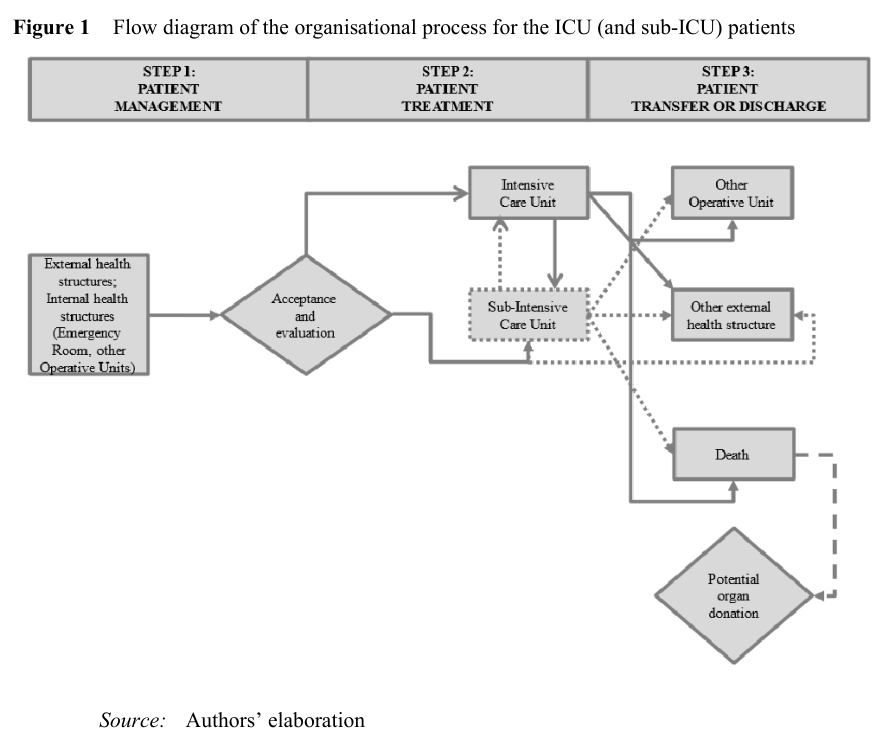
It should be mentioned that the data analysed in the study have been extracted from the electronic medical records (EMRs) only with reference to past admissions, for which related permission to access the data (as per the General Data Protection Regulation 2016/679) was opportunely acquired. Thus, no participants were recruited for clinical trials. Figure 1 provides the CP template that is normally adopted in the ICU of CSS (and naturally in most of the ICUs of other healthcare organisations). This evidence was necessary to understand where to identify, collect, extract, prepare, and aggregate the different data to be processed in the analysis (i.e., patient treatment > ICU). The data extraction period includes four years (from 1 January 2018 to 31 December 2021), with the aim of detecting and exploring possible changes in the organisation of the CPs due to the COVID-19 pandemic outbreak; only 2018 and 2019 were selected to maintain coherence (2 + 2) with the COVID-19 years (2020 and 2021). Four categories of data were extracted, as follows:
1 patient information (e.g., age, gender, date of admission, date of discharge, and so on)
2 records for the direct use of the CPs (e.g., date of admission, date of transfer to and from the ICU, number of readmissions, name of the disease, and so on)
3 register of the medical care (e.g., type and number of services performed at the radiology unit, date of execution, and so on)
4 register of healthcare workers (e.g., number of nurses, number of professional caregivers, and so on).
Naturally, of the abovementioned databases, the fourth does not concern patients. Applying the query, that is, non-COVID-19 patients with respiratory insufficiency treated in the ICU in the 2018–2021 period, to the first three abovementioned databases of CSS, 749 patients (already normalised with respect to hospitalisations) were found.
4. Data setting, data sources, and data detection
All the items for the data analysis have been defined using elements from the four databases. The primary outcome of this study, that is, the length of hospitalisation in the ICU, was calculated as the difference between the entry date of the patient in the subsequent Operative Unit (cf. Figure 1) and the entry date of the patient in the ICU. To obtain further and more detailed information on the management of the CP before (2018–2019) and during/after (2020–2021) the COVID-19 emergency, data relating to the number of radiological services performed and the number of healthcare workers employed in the coherent period were collected. Some variables have been prevailingly used as exploratory:
1 sex (used as an element from the patient information database)
2 age (considered as the difference between the date of hospitalisation and the date of birth)
3 readmission (yes or no, used as an element from the CP information database; a readmission is a further hospitalisation of the same patient in the same year)
4 number of days of hospitalisation (used as an element of evaluation of the clinical efficiency, with all the related limitations)
5 hospital discharge (used as an element from both the patient information and the CP database).
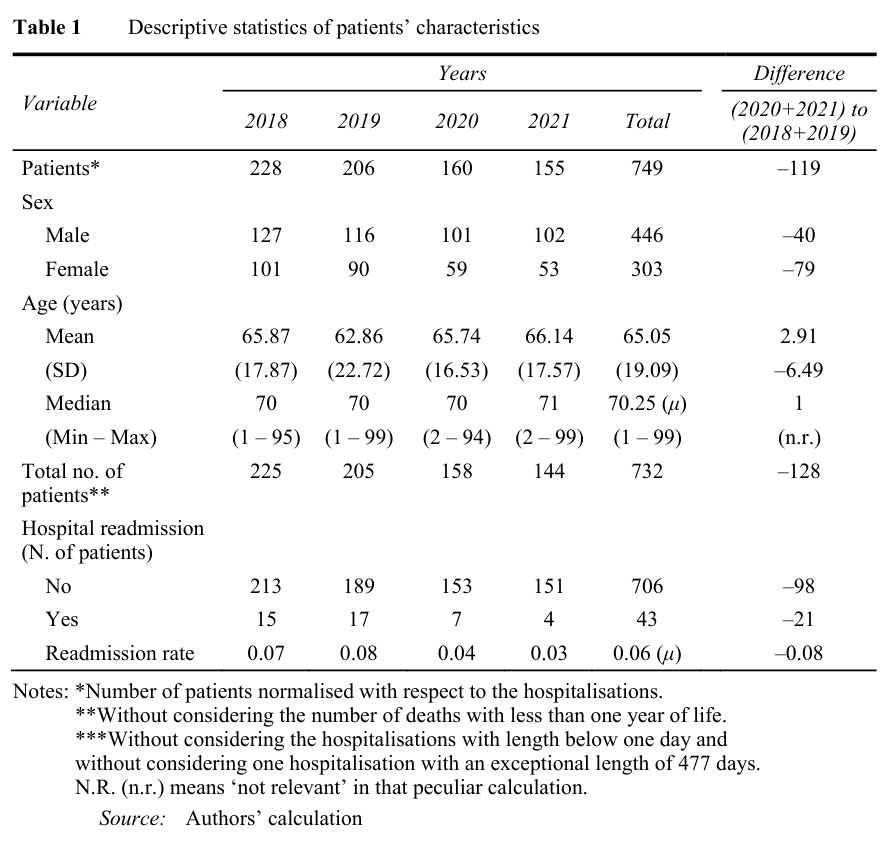
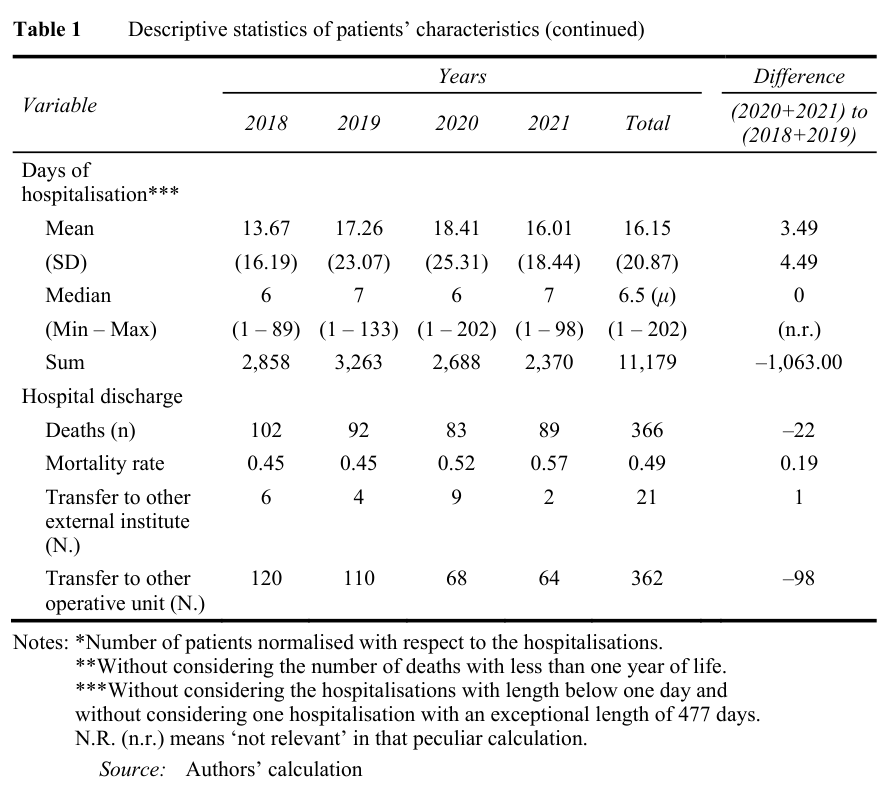
Table 1 presents the patients’ characteristics respectively before (2018–2019) and after (2020–2021) the start of the COVID-19 pandemic, with the last column providing the evidence of the differences (when relevant).
The abovementioned outcomes have then been commented on from the perspective of exploring the potential impact of the COVID-19 outbreak on the healthcare organisation. Naturally, other clinical, managerial, and financial variables could have interfered in the 2020–2021 period, but the COVID-19 pandemic is reasonably the most relevant reason for any change that has occurred.
5. Outcomes of the investigation
As highlighted, the main exploratory variables of the patients under investigation are sex, age, readmission, number of days of hospitalisation, and hospital discharge (cf. Table 1). The results of the data analysis would provide information on possible changes comparing the clinical performances before and after the outbreak of the COVID-19 pandemic (with the consequent organisational, managerial, and financial impacts). The primary outcome of the research consisted of comparing the duration of the hospital stay in the ICU [and related mean, standard deviation (SD), and median] with the respective minimum and maximum numbers of days of hospitalisation. The evidence shows an increase of the average duration of stay (the increase of the average is equal to 3.49 days, but with significant variability, since the increase of the SD is equal to 4.49), due to the COVID-19 outbreak (less availability of hospital beds inevitably necessitated that access to the ICU be granted only to those non-COVID-19 patients who were severely affected). For a more in-depth interpretation of these data, Figure 2 reports the median and maximum durations of hospitalisation for the four years under investigation. For the abovementioned reasons (i.e., ‘without considering the hospitalisations with length below one day and without considering one hospitalisation with an exceptional length of 477 days’), the minimum number of hospitalisation days has been set to one.
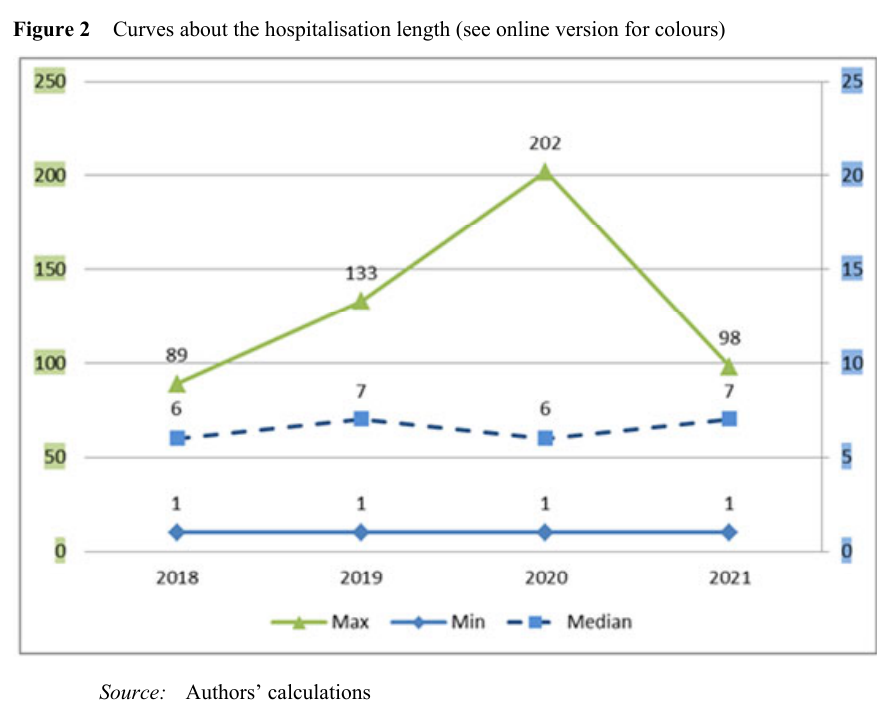
The average value of the median is 6.5 days and, moreover, comparing the years in the absence (2018–2019) and presence (2020–2021) of the COVID-19 emergency, it can be noted that the trend of the curve of the median does not undergo significant changes. The curve that describes the evolution of the peaks of hospitalisation length shows an increasing trend until the year 2020 (when the maximum, i.e., 202, was recorded for the four years under investigation), followed by a rapid decline in 2021, when it was in fact even lower than in 2019 (98 instead of 133). In addition to the previous outcome, which remains the main result of the research, two other investigations have been performed to enrich the global evaluation of the evolution of the efficiency of the CP: first, the analysis in Figure 3, comparing the number of radiological exams performed on patients (with financial interest); and second, the average number of healthcare workers employed (with managerial interest) in Table 2.
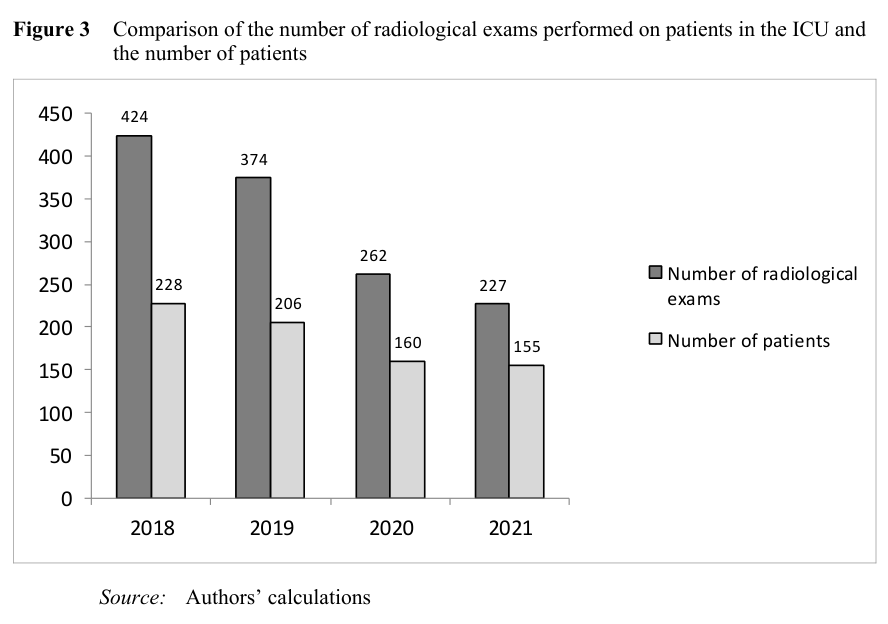
Table 2, more particularly, shows the number of healthcare workers of ICU during the four years (it is to highlight that by ‘healthcare workers’, in this case, we intend nurses and professional caregivers, not including doctors, paramedics, and technicians). Since 2020, with the outbreak of the COVID-19 pandemic, the increase in the number of these healthcare workers, especially nursing staff, is noteworthy.
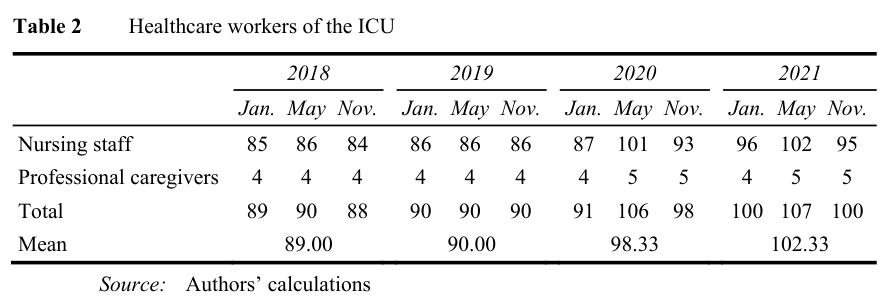
January 2020 was the last month before COVID-19 in Italy; May 2020 was the month of exit from the first lockdown in Italy; and November 2020 was the month with a substantial new lockdown in Italy. To maintain some temporal coherence, the same months have also been adopted as points of reference for the other three years under investigation (2018, 2019, and 2021). Finally, Figure 4 shows the temporal changes of the three main variables studied in this research. As can be observed, the number of days of hospitalisation and the number of healthcare workers tend to increase, while the number of radiological exams (weighted by the number of patients) tends to decrease.
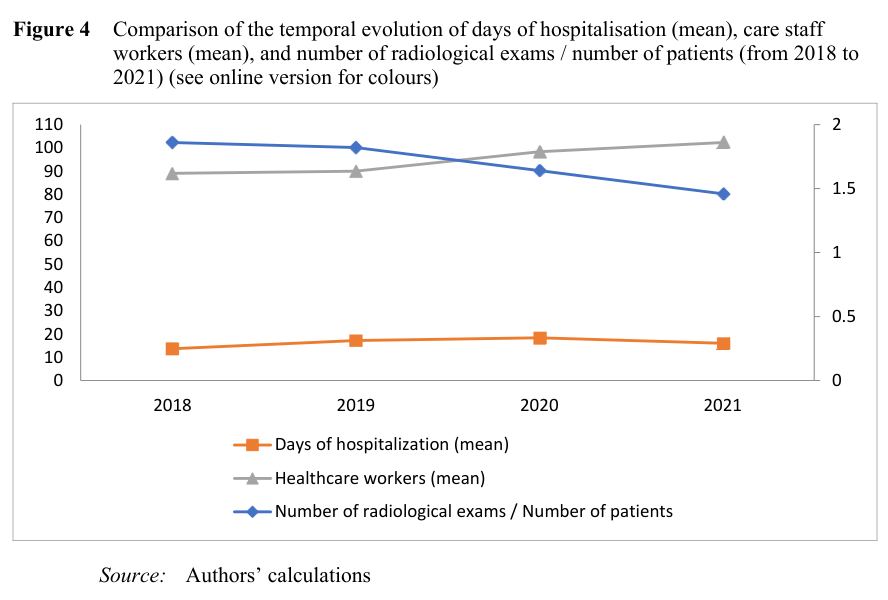
Thus, Figure 4 provides a general summary of the main outcomes of the research. The curve marked with square-shaped symbols shows the average trend of the hospitalisation days for the four years; the peak was reached, for the period under analysis, in 2020, with the outbreak of the COVID-19 pandemic; this evidence seems due to the understandable unreadiness to face a pandemic with that dimension and impact, particularly from an organisational point of view. Instead, the curve marked with triangle-shaped symbols shows the number of healthcare workers in the ICU. It goes from a minimum average level of 89 units in 2018 to a maximum average level of 102 in 2021, and this evidence is directly connected to the need to react from an organisational point of view to the pandemic outbreak. Finally, the curve marked with rhombus-shaped symbols shows the number of the radiological exams that were carried out, which, as previously highlighted, has decreased. It should be mentioned that this is a very significant indicator from the clinical, managerial, and financial points of view.
6. Discussion of the results
The main outcome of the research, as mentioned above, concerns the evidence emerging from the detailed investigation of hospital stays. The intention, as per the general aim of the study, is to understand if and how the modifications to the healthcare organisation due to the COVID-19 emergency have impacted the CPs. The first result of the current examination (i.e., the CPs related to non-COVID-19 patients with respiratory insufficiency) is that the maximum length of hospitalisation for the year 2021 (98 days) is lower than the maximum length of hospitalisation for the year 2019 (133 days). This appears as a significant achievement, showing increased awareness from an organisational point of view, due to the huge experience that the CSS has undergone, like all other healthcare organisations, because of the pandemic management. In truth, it should be mentioned that in 2020 and 2021 (cf. Table 1) the global sum of the number of days of hospitalisation decreased, because of the hospitalisation of fewer patients and even though there was increase in the average number of days of hospitalisation (with an average length of stay that was higher in 2020 than in 2021), since almost the half of the hospital beds were reserved for COVID-19 patients in that period. Thus, the evidence is that fewer patients (with respect to 2018 and 2019) have had a longer stay than in the previous years (2020 > 2018, 2020 > 2019, 2021 > 2018, and only 2019 < 2021), most probably because of emerging procedures connected to COVID-19 treatment even for non-COVID-patients and because of the different proportion of the healthcare workers engaged in the treatment of non-COVID-patients (which naturally was 100% before the COVID-19 pandemic). As concerns the efficiency of the CPs, from Figure 3 it is evident that the number of radiological exams (fundamental for the clinical success of the healthcare process) carried out in the years 2020 and 2021 showed a large decrease when compared to those carried out in the years 2018 and 2019 with respect to the total number of hospitalised patients (with a slight decrease in the readmission rate and a slight increase in the mortality rate). This evidence can be attributed to two main factors:
1 the decrease of the total number of non-COVID-19 patients; and most of all
2 the prevention of possible risks of COVID-19 infection during the transport of patients from the ICU to the radiological unit for performance of the related exams (in this respect, in terms of organisational change or at least in terms of organisational improvement, further increasing the number of personnel units in this process would probably ensure a level of care similar to the pre-COVID-19 years).
In fact, from Table 2 it is evident that a more significant number of staff were employed in the years 2020 and 2021 when compared to the two pre-COVID-19 years. It can be assumed that the emergency necessitated the employment of new personnel units to manage the crisis, with a global increase in the number of ICU personnel in general, but, as abovementioned, these staff were differently distributed for COVID-19 and non-COVID-19 patients (and most probably this is a first relevant impact from a managerial point of view), and then even a further increase in terms of human capital, and, in general, intellectual capital (Festa et al., 2021b), is recommended to support adequate corporate performance in times of uncertainty (Marcarelli, 2018; Naoum et al., 2022). Finally, the previous reflections, considering the abovementioned changes, seem to provide sufficient evidence to respond to the RQ (Has the COVID-19 pandemic changed the organisation and management of non-COVID-19 CPs? – Yes). At the same time, it should be mentioned that this result needs continuous investigation in further research; in fact, the detected changes require constant monitoring in the future, also in the light of the potentially different circulation of the virus.
7. Scientific and managerial implications
From a theoretical point of view, the main scientific consequences deriving from the evidence that emerged from the current study concern the methodological vision of the functioning of the healthcare organisations, which are increasingly oriented, for many different reasons, to innovation management and risk management (Festa et al., 2022; Kolte et al., 2022). If in normal circumstances a more innovative and less risky healthcare CP develops greater competitiveness in the healthcare market (from the perspective of excellence), in exceptional circumstances, such as the COVID-19 pandemic, a more innovative and less risky CP represents a response that is only adequate for the contextual competitiveness in the healthcare market (from the perspective of the standard), even though one could think that an adequate response to an exceptional circumstance could in truth constitute an almost excellent response. In this respect, the necessity of a broad multidimensionality of the business vision in the healthcare sector, at public or private level, emerges with even more emphasis; in fact, a purely clinical response to an environmental change, normal under normal circumstances or exceptional as in the case of COVID-19, would clash with the consequent financial unsustainability, which would imply appropriately treating (from a clinical point of view) some patients, while at the same time not having the capability to properly treat all the others. Instead, only a multidimensional vision (at clinical, organisational, operational, and financial level) makes it possible to plan, deliver, and, in the event of an emergency, react in a sustainable manner in favour of the health of the entire community. From a practical point of view, the main scientific consequences deriving from the evidence that has emerged from the current study concern the need to constantly revise the CPs, with a view to continuous improvement as prescribed by any quality management system (formal or informal). Normally, in fact, constant revisions allow for incremental innovation, but in the case of exceptional circumstances, such as the COVID-19 pandemic, continuous revisions allow for radical innovation, which in the case study under investigation is highlighted by the significant changes concerning the duration of hospitalisation (with clinical interest), the number of healthcare personnel (with managerial interest), and the number of radiological exams (with clinical and financial interest). CPs, in fact, owe their constant innovation not only to the evolution of the medical science in a broad sense, but also to the evolution of the organisational, managerial, and financial skills that contribute to their efficient management or at least to their appropriate management. In this respect, it becomes essential to proceed with continuous training of the operators involved in the CP, both health and non-health, in all the issues of interest for that specific CP (and, therefore, also in the organisational, managerial, and financial problematics).
8. Research limitations and future directions
The research has some shortcomings. First, there are the limitations that are usually existent in a case study methodology; that is, the data are related to the experience in a single hospital, whose evidence, although chosen as an extreme case (or perhaps particularly for this reason), cannot be assumed to apply to other healthcare organisations at national and international levels. In truth, Bosa et al. (2021) hold that differences in pandemic management have been found between and within regions, emphasising the intrinsic limits of a case study (thus, in the progress of the research, more data, with reference to a larger number of healthcare organisations, could be very useful). Second, the CP under investigation was analysed for a single unit (ICU) and was focused on the treatment of very particular patients (non-COVID-19 patients with respiratory insufficiency). Therefore, expanding the number and variety of CPs could provide more reliability to the evolution of the research. Finally, to date, it seems that very few studies have analysed the impact of COVID-19 on specific non-COVID-19 CPs, and most of all with a global approach, that is, considering the clinical, organisational, managerial, and financial perspectives. Thus, this study has been implemented adopting an exploratory intent, with the related limitations concerning its theoretical and practical impact, which in truth seems however noteworthy.
9. Conclusions
Despite the tremendous impact of the COVID-19 pandemic on healthcare systems, CPs remain an effective tool to ensure better quality of care for patients. More specifically, they are fundamental for reducing the length of hospitalisation, which is a clinical performance indicator with relevant meaning also at managerial and financial levels (Trimarchi et al., 2021). In this study, a group of 749 patients (non-COVID-19 patients in the ICU with respiratory insufficiency) has been investigated, showing an increase in the number of days of hospitalisation (with clinical interest), an increase of the number of healthcare workers (with managerial interest), and a decrease in the number of radiological exams (with clinical and financial interest). Finally, it should be mentioned that, in the case study under analysis, the impact of the COVID-19 pandemic has been relevant, forcing the adoption of several changes at organisational level not only to manage the pandemic emergency but also to provide a response to ‘standard’ patients, with greater complexity due to the COVID-19 situation, and that only a systemic vision of the CPs, considering altogether the related clinical, organisational, managerial, and financial dimensions, has allowed appreciable outcomes to be recorded even in times of COVID-19.
Acknowledgements
This article is the result of the common reflection of all the authors. The authors want to thank Dr. Luigi Pacilli, Health Executive Director at the Casa Sollievo della Sofferenza Research Hospital, San Giovanni Rotondo, FG, Italy, EU; and Dr. Saverio Fusilli, Director of the Epidemiology, Statistics, and Health Information Flows Operations Unit at the Casa Sollievo della Sofferenza Research Hospital for their collaboration in providing data and information for the case study under analysis.
References
Al-Habib, N.M.I. (2020) ‘Leadership and organizational performance: is it essential in healthcare systems improvement? A review of literature’, Saudi Journal of Anaesthesia, Vol. 14, No. 1, pp.69–76.
Al-Tawfiq, J.A., Al-Yami, S.S. and Rigamonti, D. (2020) ‘Changes in healthcare managing COVID and non-COVID-19 patients during the pandemic: striking the balance’, Diagnostic Microbiology and Infectious Disease, Vol. 98, No. 4, p.115147.
Bosa, I., Castelli, A., Castelli, M., Ciani, O., Compagni, A., Galizzi, M.M., Garofano, M., Ghislandi, S., Giannoni, M., Marini, G. and Vainieri, M. (2021) ‘Corona-regionalism? Differences in regional responses to COVID-19 in Italy’, Health Policy, Vol. 125, No. 9, pp.1179–1187.
Burgers, P.T.P.W., Van Lieshout, E.M.M., Verhelst, J., Dawson, I. and de Rijcke, P.A.R. (2014) ‘Implementing a clinical pathway for hip fractures; effects on hospital length of stay and complication rates in five hundred and twenty six patients’, International Orthopaedics, Vol. 38, No. 5, pp.1045–1050.
Devailly, J-P. and Josse, L. (2016) ‘Clinical pathway: a link between medical appropriateness and fair payment’, Annals of Physical and Rehabilitation Medicine, Vol. 59, No. 2016-S, pp.e45–e46.
Dhar, R., Jee, B., Pethusamy, K., Seethy, A., Kumar, A. and Karmakar, S. (2020) ‘The scars of COVID-19: preparing for the collateral damages’, Asian Journal of Medical Sciences, Vol. 11, No. 6, pp.142–147.
Donelli, C.C., Fanelli, S., Zangrandi, A. and Elefanti, M. (2022) ‘Disruptive crisis management: lessons from managing a hospital during the COVID-19 pandemic’, Management Decision, Vol. 60, No. 13, pp.66–91.
Eisenhardt, K.M. (1989) ‘Building theories from case study research’, The Academy of Management Review, Vol. 14, No. 4, pp.532–550.
Festa, G., Chirico, S., Chouaibi, J. and Civitillo, R. (2021a) ‘Cultural approach to healthcare risk management – an Italian experience with look-alike, sound-alike drugs’, International Journal of Managerial and Financial Accounting, Vol. 13, No. 1, pp.64–79.
Festa, G., Kolte, A., Carli, M.R. and Rossi, M. (2022) ‘Envisioning the challenges of the pharmaceutical sector in the Indian health-care industry: a scenario analysis’, Journal of Business & Industrial Marketing, Vol. 37, No. 8, pp.1662–1674.
Festa, G., Rossi, M., Kolte, A. and Marinelli, L. (2021b) ‘The contribution of intellectual capital to financial stability in Indian pharmaceutical companies’, Journal of Intellectual Capital, Vol. 22, No. 2, pp.337–359.
Flics, S., Duggal, S., Kujawa, K. and Cornell, C.N. (2020) ‘Introduction of clinical pathways in orthopedic surgical care: the experience of the hospital for special surgery’, in MacKenzie, C., Cornell, C. and Memtsoudis, S. (Eds.): Perioperative Care of the Orthopedic Patient, pp.437–443, Springer, Cham, Switzerland.
Florin, M., Pinar, U., Chavigny, E., Bouaboula, M., Jarboui, L., Coulibaly, A., Lemogne, C. and Fournier, L. (2020) ‘Socio-economic and psychological impact of the COVID-19 outbreak on private practice and public hospital radiologists’, European Journal of Radiology, Vol. 132, No. 2020, p.109285.
Furuhata, H., Araki, K. and Ogawa, T., (2020) ‘Causation between pathway completion and reduced hospital stay in patients with lung cancer: a retrospective cohort study using propensity score matching’, Journal of Medical Systems, Vol. 44, No. 6, pp.105–114.
Furuhata, H., Araki, K., Ogawa, T. and Ikeda, M. (2017) ‘Effect on completion of clinical pathway for improving clinical indicator: cases of hospital stay, mortality rate, and comprehensive-volume ratio’, Journal of Medical Systems, Vol. 41, No. 12, pp.206–214.
Hart, D. (2003) ‘Risk management, clinical guidelines, clinical pathways and health law’, European Journal of Health Law, Vol. 10, No. 3, pp.219–222.
Haugan, A., Johnsen, L.G., Basso, T. and Foss, O.A., (2017) ‘Mortality and readmission following hip fracture surgery: a retrospective study comparing conventional and fast-track care’, BMJ Journals, Vol. 7, No. 8, pp.1–8.
Jalili, M., Niroomand, M., Hadavand, F., Zeinali, K. and Fotouhi, A. (2021) ‘Burnout among healthcare professionals during COVID-19 pandemic: a cross-sectional study’, International Archives of Occupational and Environmental Health, Vol. 94, No. 2021, pp.1345–1352.
Khandelwal, R., Kolte, A. and Rossi, M. (2022) ‘A study on entrepreneurial opportunities in digital health-care post-COVID-19 from the perspective of developing countries’, Foresight, Vol. 24, Nos. 3/4, pp.527–544.
Kolte, A., Festa, G., Rossi, M., Thrassou, A., Vrontis, D. and Christofi, M. (2022) ‘Ambidexterity’s influence on export strategy development – the case of the Indian pharmaceutical industry’, Thunderbird International Business Review, Vol. 64, No. 5, pp.465–476.
Konishi, T. (2003) ‘Safety improvement through implementation of clinical pathways’, Nihon Geka Gakkai Zasshi (Journal of Japan Surgical Society), Vol. 104, No. 1, pp.23–28.
Lawal, A.K., Rotter, T., Kinsman, L., Machotta, A., Ronellenfitsch, U., Scott, S.D., Goodridge, D., Plishka, C. and Groot, G. (2016) ‘What is a clinical pathway? Refinement of an operational definition to identify clinical pathway studies for a Cochrane systematic review’, BMC Medicine, Vol. 14, No. 35, pp.1–5.
Lin, D-X., Li, X., Ye, Q-W., Lin, F., Li, L-L. and Zhang, Q-Y. (2011) ‘Implementation of a fast-track clinical pathway decreases postoperative length of stay and hospital charges for liver resection’, Cell Biochemistry and Biophysics, Vol. 61, No. 2, pp.413–419.
Marcarelli, G. (2018) ‘An integrated network model for performance management: a focus on healthcare organisations’, International Journal of Managerial and Financial Accounting, Vol. 10, No. 2, pp.163–180.
Mediani, H.S., Adistie, F., Hendrawati, S. and Trisyani, Y. (2022) ‘Problems facing healthcare providers when caring for COVID-19 patients: an integrative review’, Journal of Multidisciplinary Healthcare, Vol. 15, No. 2022, pp.1511–1523.
Naoum, V-C., Ntounis, D. and Vlismas, O. (2022) ‘Strategy, intellectual capital and operating performance’, International Journal of Managerial and Financial Accounting, Vol. 15, No. 1, pp.50–87.
Nielsen, A.S. and Nielsen, B., (2015) ‘Implementation of a clinical pathway may improve alcohol treatment outcome’, Addiction Science & Clinical Practice, Vol. 10, No. 1, pp.1–7. Romeyke T. and Stummer, H. (2012) ‘Clinical pathways as instruments for risk and cost management in hospitals - a discussion paper’, Global Journal of Health Science, Vol. 4, No. 2, pp.50–59.
Roy, C.M., Bollman, E.B., Carson, L.M., Northrop, A.J., Jackson, E.F. and Moresky, R.T. (2021) ‘Assessing the indirect effects of COVID-19 on healthcare delivery, utilization and health outcomes: a scoping review’, European Journal of Public Health, Vol. 31, No. 3, pp.634–640.
Schettini, I., Palozzi, G. and Chirico, A. (2022) ‘Mapping the service process to enhance healthcare cost-effectiveness: findings from the time-driven activity-based costing application on orthopaedic surgery’, in Pfannstiel, M.A., Brehmer, N. and Rasche, C. (Eds.): Service Design Practices for Healthcare Innovation, pp.235–251, Springer, Cham, Switzerland.
Trimarchi, L., Caruso, R., Magon, G., Odone, A. and Arrigoni, C. (2021) ‘Clinical pathways and patient related outcomes in hospital-based settings: a systematic review and meta-analysis of randomized controlled trials’, Acta Biomedica, Vol. 92, No. 1, pp.1–13.
Tsamakis, K., Tsiptsios, D., Ouranidis, A., Mueller, C., Schizas, D., Terniotis, C., Nikolakakis, N., Tyros, G., Kympouropoulos, S., Lazaris, A., Spandidos, D.A., Smyrnis, N. and Rizos, E. (2021) ‘COVID-19 and its consequences on mental health (review)’, Experimental and Therapeutic Medicine, Vol. 21, No. 3, pp.1–7.