Abstract
Purpose: The scope of this paper is to provide a defined, refined, and comprehensive understanding of the association between marketing strategies and corporate finance and accounting by conducting a systematic literature review of the interfaces of corporate marketing strategies and finance.
Design/methodology/approach: We undertake a two-stage critical analysis of the marketing strategy literature in relation to stock valuation, corporate financing, and performance evaluation, and subsequently synthesize the existing findings utilizing a multi-theoretical and multi-disciplinary framework.
Findings: A systematic analysis of 116 journal articles was performed over the period 1989-2024 and indicated that the interface between marketing strategies and financial outcomes is a vibrant and growing stream of research, with important implications for researchers. The findings also pinpoint some literature trends and gaps, along with the complexity and other research challenges in the relations between various marketing strategies and financial issues.
Originality/Value: This study enhances the knowledge base of marketing strategies and finance by merging multiple insights from different theoretical streams, allowing a thorough understanding of this issue and providing useful implications for researchers.
Keywords: Marketing strategies, Accounting, Corporate finance, Systematic review.
Paper type: Literature review
Introduction
Marketing's major purpose is to provide value for consumers and meet corporate financial expectations; however, this requires many marketing expenditures and expenses (Foster and Gupta, 1994). This characteristic boosted the literature on marketing tactics and corporate finance and accounting. Product market spending visibility may directly and measurably affect investors' attention and conduct (Sharpe, 2021). Since stock returns are linked to disclosed and reported strategic orientation adjustments, Gensler et al. (2023) point out that investors want corporations to match their marketing strategy orientation with their financial aims and value creation. Celebrity endorsements, green crowdfunding, and consumer resilience programs during extreme crises affect stock valuations, investment intentions, firm values, and fundraising.
Stewart (2009) claims that marketing activities and strategies consume roughly a quarter of a firm's yearly budget. Sydney-Hilton and Vila-Lopez (2019) list branding, communication, price, and service as the biggest marketing expenditures, which affect accounting metrics, performance, and corporate finance. Companies that engage in brand creation may increase sales and profit (Madden et al., 2006). Sydney-Hilton and Vila-Lopez (2019) claim that such items increase earnings and long-term stock returns because buyers are prepared to pay more. Marketing communications have gained speed (particularly with social media development) as an effective vehicle for reaching the intended audience, affecting cost-effectiveness, return on investment, and financial performance.
Despite the abundance of marketing strategy literature, its intersection with accounting and corporate finance is understudied. Many academics agree with Stewart (2009) that marketing should be more responsible and prove its value to the enterprise (DeKimpe and Hanssens, 1995; Luehrman, 1998). Following this logic, numerous researchers argue that practitioners must grasp how marketing standards relate to financial success, shareholder value, and growth. Marketing accountability research has just grown in the recent decade, yet quantifying marketing strategy efficiency appears to be difficult (Foster and Gupta, 1994).
The scope of this study is to provide a defined, refined, and comprehensive understanding of the association between marketing strategies and corporate finance and accounting by conducting a systematic literature review on the interfaces of corporate marketing strategies and finance. Specifically, we attempt to answer the following research question: What are the implications of marketing strategies for business accounting performance and financing decisions? To answer this question, we undertake a critical analysis of the marketing strategy literature in relation to stock valuation, corporate financing, and performance evaluation, and subsequently synthesize the existing findings utilizing a multi-theoretical and multi-disciplinary framework and present avenues for future research.
This is the first systematic literature review on this topic, responding to calls for more research by Morgeson III et al. (2024), Sydney-Hilton and Vila-Lopez (2019) and Gensler et al. (2023), identifying several theoretical and methodological gaps in the literature as well as limitations and emerging issues and trends within extant published research, which constitute a constructive agenda for future researchers. In addition, the current study is motivated by the shortage of previous review studies providing a synthesis of the knowledge on this issue. The most recent study by Nerantzidis et al. (2024) analyses 86 articles yet is focusing only on one form of marketing communication (social media). Thus, our study extends previous systematic reviews in terms of sample size, time coverage (116 papers over three decades) and marketing strategies, beyond corporate communication.
Research design
The paper’s research topic focused on how marketing techniques affect accounting and corporate finance results in firms. Following Vrontis and Christofi (2021) and Dimitropoulos et al. (2023), we selected research publications for this systematic review using certain criteria. First, we chose Web of Science (WoS) and Scopus databases for research tools since they cover marketing and accounting/finance journals extensively. Second, to avoid missing a crucial term that may provide relevant results, we constructed a collection of research keywords with comprehensive coverage. Third, we did not limit the collection of linked publications; it was kept open until the conclusion of the study period, December 2024.
Following Dimitropoulos et al. (2023) and Christofi et al. (2017), we examined the Title, Abstract, and Keyword fields within the digital libraries of Scopus and WoS, because these sections typically include key phrases for each article. The keywords were truncated to identify all relevant journal articles (published in English) that contained keyword variations. In addition, each group’s key phrases were correlated using the Boolean OR/AND operator to generate a research string. The research formula utilized was (“Marketing strategies”) AND (“Corporate finance”) AND (“Accounting” OR “Financial Accounting” OR “Corporate accounting”). The basic literature search generated 851 papers from both databases.
These 851 studies were further evaluated based on a set of exclusion criteria. First, in accordance with the methodology of current systematic reviews (Nerantzidis et al., 2024; Dimitropoulos et al., 2023), the research was focused on articles in peer-reviewed scientific journals with full texts. Book chapters, editorials, conference papers, extended abstracts, and book reviews were eliminated from the search. Second, non-English articles were removed from the search and duplicates were excluded. The exclusion parameters yielded a valid sample size of 593 papers, which were thereafter examined according to the scope of this study.
The first evaluation of 593 publications reviewed article titles, abstracts, and, in some cases, introductions. This approach removed 456 unnecessary articles, leaving 137. The third level of inspection removed 25 additional papers after examining the entire texts, and we only selected those that were highly related to the study issue and presented substantial viewpoints on marketing strategies, accounting, and corporate finance. The final sample included 112 articles from the third assessment phase. According to Vrontis and Christofi (2021), we ran a snow-balling manual search of the 112 qualifying publications' references to find noteworthy studies linked to the study issue that were missed by prior searches. The overall number of sampled articles increased to 116 after retrieving four more relevant publications. Table 1 describes the literature search and selection process.
| Search Strategy Stages | Number of Papers |
|---|---|
| Stage 1 | |
| Articles collected by Scopus (including duplicates) | 328 |
| Articles collected by Web of Science (including duplicates) | 280 |
| Sum of articles of 1st stage | 608 |
| Less: Duplicates removed | (15) |
| Final number of articles from 1st stage | 593 |
| Stage 2 | |
| Less: Articles excluded based on title and abstract review | (456) |
| Final number of articles from 2nd stage | 137 |
| Stage 3 | |
| Less: Articles excluded based on full text review | (25) |
| Final number of articles from 3rd stage | 112 |
| Stage 4 | |
| Articles added after searching the reference lists of selected articles from Stage 3 | 4 |
| Final sample of articles | 116 |
Marketing strategies can produce several types of outcomes, ranging from short-term revenue growth to long-term competitive advantages. This study builds on the typology of the returns of marketing strategies (and investments) developed by Stewart (2009) and categorizes the financial and accounting outcomes of marketing strategies into three categories: a) short-term (incremental) effects, b) long-term (persistent) effects, and c) real options (future opportunities) effects. According to Stewart (2009), the marketing discipline has been efficient and successful in identifying and measuring the short-term effects of marketing strategies on financial outcomes or other forms of performance, including consumer preference or purchase intention, revenue growth, store visits, and e-store visits, all of which are linked to cash flow generation. The second type of return on marketing strategy has a long-term focus and refers to results that mature or bear financial benefits to the firm, at least for some period into the future (DeKimpe and Hanssens, 1995). The third type of marketing strategy return is among the most important; yet it is the least researched and identified within the marketing discipline. Real options represent opportunities with real values that a firm may pursue in the future. Future opportunities can be created by cooperative advertising, which can provide more recognition distribution or shelf space for the firm’s product. Alternatively, brand strategies before or after a merger or acquisition activity can have positive results in terms of firm value, customer retention, or market share (Luehrman, 1998). Consequently, the analysis and data synthesis in the forthcoming section follow Stewart’s (2009) categorization of marketing strategies based on the time horizon of the produced outcomes.
Results and data synthesis
Reviewing the selected sample articles revealed some interesting research trends. First, we categorized the chosen articles by number of authors, countries involved (based on author location), and institutions involved. The relevant findings are presented in Table 2. Most papers had two (n = 41; 35%) or more authors (n = 55; 47%), suggesting strong cooperation among researchers on this issue. These authors are largely from one country (n = 88; 76%) or two (n = 20; 17%), showing that few published papers have multinational authorship teams. Finally, the majority of our chosen papers included researchers from two (n = 41; 35%) and three or more (n = 60; 52%) academic institutions, demonstrating strong institutional collaboration on this study issue. The US had the most researchers (n = 48; 41.4%), followed by the UK and Australia with seven (6%), Canada and Italy with six (5.2%).
| Categorization by number of authors | Number | Percentage |
|---|---|---|
| One | 20 | 17.24% |
| Two | 41 | 35.34% |
| Three or more | 55 | 47.41% |
| Categorization by number of countries | Number | Percentage |
| One | 88 | 75.86% |
| Two | 20 | 17.24% |
| Three or more | 8 | 6.90% |
| Categorization by number of institutions | Number | Percentage |
| One | 16 | 13.79% |
| Two | 41 | 35.34% |
| Three or more | 60 | 51.71% |
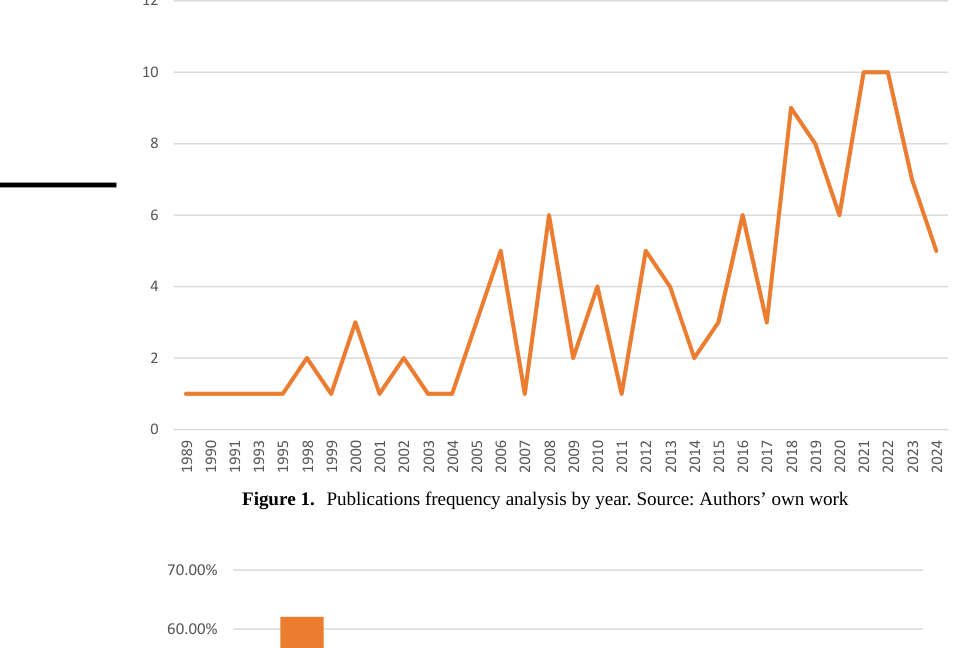
The first papers on the examined topic were published at the end of the 1980s, specifically in 1989 and 1990. Since 2000, the number of published articles has shown an increasing trend. Figure 1 provides the time-series evolution of selected publications until the end of 2024. Even though the specific research field started to concern researchers more than 35 years ago, research on this topic surged around 2005. In particular, the results indicate that the number of scholarly outputs increased from 3 studies in 2000 to 6 in 2008, with a further increase to 10 in 2022 and 2023. As for 2024, only five papers on this topic were published in this domain.
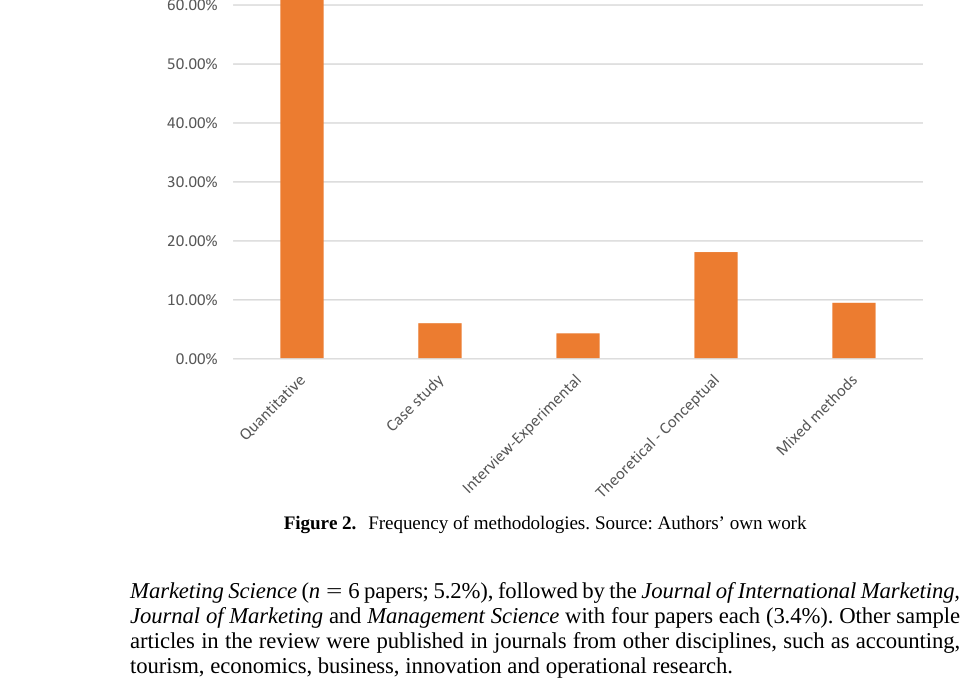
Moreover, the evolution of this research field is evidenced by the variety of methodologies that researchers have followed, along with the diversity of scientific regimes that have examined this specific topic. Figure 2 provides a snapshot of the different methodologies employed in the sample articles. Most of the selected studies followed a quantitative type of analysis (almost 60% of the sample papers), while theoretical-conceptual research designs were the second most popular methodology (almost 20% of the sampled papers). Mixed methods, case studies, and interviews were the least selected methodologies (10%, 5%, and 4% of the sampled papers respectively).
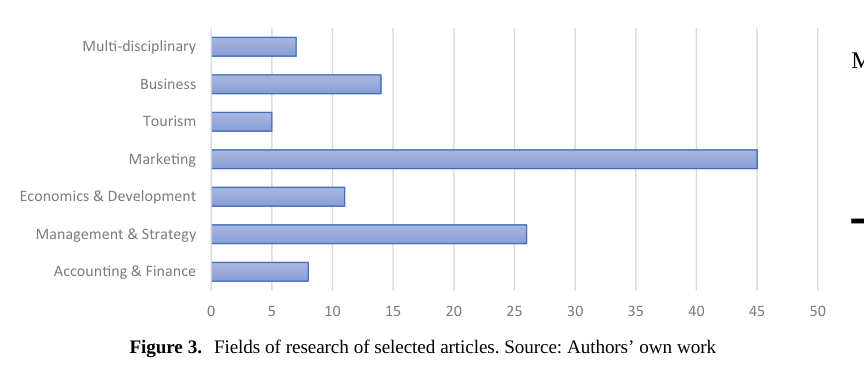
Furthermore, Figure 3 provides a snapshot of the different scientific regimes that have examined the association of marketing strategies with accounting and finance issues. Of course, most of the sampled papers were from Marketing (n = 45) and Management (n = 27) fields, followed by Business (n = 14) and Economics (n = 11). However, the association between marketing strategies, accounting, and corporate finance has gained the attention of researchers in Tourism (n = 5), Accounting and Finance (n = 8), and multi-disciplinary research fields (n = 7). This was further corroborated by the journals publishing these papers. The most popular journals on this topic are the European Journal of Marketing (n = 6 papers; 5.2%) and Marketing Science (n = 6 papers; 5.2%), followed by the Journal of International Marketing, Journal of Marketing, and Management Science with four papers each (3.4%). Other sample articles in the review were published in journals from other disciplines, such as Accounting, Tourism, Economics, Business, Innovation and Operational Research.
4. Discussion
Effective advertising, especially in the digital age, drives revenue and offers strategic benefits. Research confirms its direct impact on customer purchases and sales. Vieira et al. (2022) show that mobile marketing increases daily income, while McAlister et al. (2016) highlight advertising’s role in boosting sales and corporate value. Beyond immediate gains, advertising shapes market dynamics. Luo and de Jong (2012) link ad investments to stock returns over decades, and Dekimpe and Hanssens (1995) suggest temporary ad spending can have lasting brand effects. Future strategies, including precision marketing and programmatic ads, enable targeted outreach. Advertising not only generates income but also fosters long-term growth and market expansion.
Brand strategies are crucial to long-term financial success. Research consistently reveals that strong brand ownership helps a firm establish premium pricing, retain customers, and weather market swings. According to Madden et al. (2006), strong brands provide a high return on investment (ROI) by building lasting customer relationships, assuring financial stability and growth. Corporate finance views branding as affecting more than short-term consumer purchases. Long-term profitability, cash flow stability, and risk minimisation are affected. Research shows that stakeholder-focused brand strategies increase customer loyalty and financial success (Mena et al., 2019). Leonidou et al. (2013) suggest that adding corporate social responsibility (CSR) into brand identity may help companies stand out.
Brand investments decrease financial risk and strengthen a company's market resiliency over time. Bharadwaj et al. (2020) found that companies with strong brands are less likely to accumulate large cash reserves due to their more predictable revenues. Brand efforts provide considerable prospective and financial benefits via customer retention. Strong brands can withstand competition, enabling market growth, strategic collaborations, and product diversification. In mergers and acquisitions (M&A), brands with significant ownership may utilise their reputation and market status to negotiate better terms.
Advertising, celebrity endorsements, sponsorships, and corporate actions influence both short-term financial results and long-term reputation. Communication strategies impact customer behaviour and stock returns. Shiva et al. (2022) found that celebrity endorsements can quickly boost stock prices, especially in cases where public figures shape consumer opinion. Beyond immediate gains, communication builds corporate reputation, essential for financial success (Blake et al., 2019; Besana & Esposito, 2021). Mazzola et al. (2006) highlight transparency and trust as key in reputation-driven industries. Companies fostering strong reputations attract investment, long-term funding, and customer loyalty. Sanchez et al. (2022) found that corporate activism can boost stock returns when aligned with consumer sentiment but may backfire if it alienates stakeholders.
Direct marketing strategies, such as CRM and loyalty programs, drive revenue and client retention. Ryals and Knox (2005) highlight customer lifetime value (CLTV) as key to assessing direct marketing’s financial impact, helping firms optimize ROI. Panzone et al. (2024) found that loyalty programs boost short-term spending and long-term profitability by increasing retention and reducing acquisition costs. The effectiveness of direct marketing depends on data analytics and personalization. With expanding consumer data, companies can tailor marketing to individual preferences, enhancing loyalty programs and returns.
Market orientation aligns marketing with firm goals like profitability, growth, and customer satisfaction. Sutarmin and Jatmiko (2016) found that integrating marketing into the value chain enhances operations and finances. It also strengthens customer satisfaction, loyalty, and retention—key drivers of revenue. Market-oriented strategies ensure adaptability to changing conditions, supporting long-term competitiveness. Kiseleva (2017) highlights real-time market intelligence as a competitive advantage, fostering continuous growth and profitability.
This literature review highlights the significant financial impact of marketing strategies over short- and long-term periods. Advertising, branding, communication, and direct marketing drive immediate revenue and recognition while fostering brand equity, loyalty, and competitive advantages. By investing in and optimizing these strategies, companies can achieve both short-term profitability and long-term success. The rise of data-driven marketing and real-time consumer insights further enhances competitiveness in an evolving market. The appendix table summarizes the findings from 116 reviewed articles by marketing strategy returns.
5. Conclusions and future research directions
Marketing strategies evolve and present opportunities for further research on their impact on short-term financial performance and long-term success. This section explores key research directions to address gaps and assess the marketing-finance link in a digital and globalized market. While advertising's impact on firm performance is well-documented, some aspects remain underexplored. Vieira et al. (2022) show that mobile marketing and influencer campaigns boost retail performance. Future research could investigate how influencer-product associations influence consumer behaviour, brand perception, and revenue in push vs. pull promotions.
McAlister et al. (2016) suggest that advertising may not drive sustained sales growth, especially for cost-leader firms. Future research should explore its impact on long-term brand equity, financial performance, and market share, particularly in competitive, low-margin industries. Studies could also examine how various advertising mediums—digital, print, and social media—affect brand visibility and sales over time. Cross-platform data can help assess integrated advertising strategies’ influence on short-term sales and brand loyalty. Additionally, future research should analyse how macroeconomic factors (e.g., recession, inflation) and firm strategies (e.g., mergers, diversification) affect advertising ROI, aiding in the development of more adaptable marketing approaches.
Brand strategies are crucial for long-term financial sustainability, but further research is needed, especially as firms prioritize sustainability and corporate responsibility. Future studies should explore brand value creation across industries and markets, examining how factors like consumer loyalty, perceived quality, and brand relationships influence financial performance. Research should also assess the impact of corporate social responsibility (CSR) on brand equity, focusing on stakeholder engagement—including customers, investors, media, and NGOs—to determine its financial effects. Additionally, studying brand spillover effects between national and private labels in multichannel environments could provide insights into how brand image shapes consumer behaviour.
As consumer expectations shift toward sustainability, businesses must balance authenticity and greenwashing. Leonidou et al. (2013) found that greenwashing erodes trust, highlighting the need for research on consumer perceptions of sustainability claims and their impact on brand loyalty and performance. Future studies could explore cross-cultural differences in responses to eco-friendly marketing, especially in regions facing varying environmental challenges. Communication strategies, including celebrity endorsements, sponsorships, corporate actions, and social media, offer further research opportunities. Shiva et al. (2022) show that celebrity endorsements boost business valuations, but future studies should examine investor behaviour and real-time stock market reactions. Research could analyse investor sentiment and stock dynamics in response to celebrity-driven marketing, particularly the influence of endorser credibility on stock returns.
Corporate activism is rising as companies address social and political issues to strengthen consumer relationships. Future research should explore its long-term effects on brand loyalty, employee satisfaction, and financial performance, especially in cross-cultural contexts. Studies could also assess how corporate activism impacts financial performance in developed vs. emerging markets, where socio-political factors shape responses. Further research could examine the relationship between corporate activism and shareholder value, analysing its influence on long-term stock prices and brand image to assess risks and rewards. Given social media's role in corporate communication, studies should also explore its use in fostering immediate engagement and long-term relationships.
Direct marketing, including CRM and loyalty programs, impacts both short- and long-term finances. Future research should explore how customer advocacy and social media engagement influence CLTV and organizational effectiveness. Additionally, studies could examine how big data and AI-driven personalization enhance customer retention and spending. Research may also investigate the role of gratitude and self-esteem in loyalty program participation and how social identity alignment strengthens brand loyalty. Predictive analytics in CRM presents a key opportunity, focusing on how data-driven insights can help anticipate consumer behaviour and optimize marketing for long-term financial success.
Market orientation strategies align marketing with business goals, but their external and internal influences remain unclear. Future research should explore how industry trends, macroeconomic conditions, and technological advancements impact these strategies across sectors. Cross-cultural studies could also provide insights into regional differences in market orientation. Further research may examine how emerging market firms adapt their strategies to local consumer preferences, economic conditions, and competition, assessing their impact on long-term profitability. Additionally, as big data, AI, and digital marketing platforms evolve, studies should explore how firms leverage digital technologies for real-time market insights, enhancing decision-making and financial success.
Future research can deepen our understanding of how advertising, branding, communication, direct marketing, and market orientation impact short-term profitability and long-term sustainability. A multidisciplinary approach integrating psychology, economics, and technology is essential to comprehending modern marketing. By addressing research gaps and exploring new opportunities, scholars can help businesses optimize marketing strategies for a digital, globalized economy. We hope this work inspires future academics to investigate these evolving challenges.
References
(Citations in asterisks are used in the systematic literature review)
*Agus Trihatmoko, Ρ. and Purnamasari, D.I. (2019), “New product pricing strategy and product performance assessment in fast moving consumer goods”, International Journal of Economics and Business Administration, Vol. 7 No. 4, pp. 417-423. DOI: 10.35808/ijeba/354
*Almeida, A., Galiano, A., Golpe, A. A. and Martín Álvarez, J. M. (2021), “The usefulness of marketing strategies in a regulated market: Evidence from the Spanish tobacco market”, E&M Economics and Management, Vol. 24 No. 2, pp. 171–188. https://doi.org/10.15240/ tul/001/2021-2-011
*Anderson, S. and Guilding, C. (2006), "Competitor‐focused accounting applied to a hotel context", International Journal of Contemporary Hospitality Management, Vol. 18 No. 3, pp. 206-218. https://doi.org/10.1108/09596110610658616
*Anderson, S.J., Chandy, R. and Zia, B. (2018), “Pathways to profits: The impact of marketing vs. finance skills on business performance”, Management Science, Vol. 64 No. 12, pp. 5559-5583. https://doi.org/10.1287/mnsc.2017.2920
*Apelt, H., Velykochyy, V., Zhehus, O., Filiuk, S. and Zhumbei, M. (2019), “Formation of a strategy for providing customer-oriented tourist services”, Academy of Strategic Management Journal, Vol. 18 No. 1, pp. 1-6. 1939-6104-18-SI-1-451.
*Aspris, A., Finch, N., Foley, S. and Meyer, Z. (2013), “Fundamental-based market strategies”, Australian Accounting Review, Vol. 23, pp. 380-392. https://doi.org/10.1111/auar.12038
*Auh,S. and Merlo, O. (2012), “The power of marketing within the firm: Its contribution to business performance and the effect of power asymmetry”, Industrial Marketing Management, Vol. 41 No. 5, pp. 861-873. https://doi.org/10.1016/j.indmarman.2011.09.021.
*Azar, O.H. (2008), “The effect of relative thinking on firm strategy and market outcomes: A location differentiation model with endogenous transportation costs”, Journal of Economic Psychology, Vol. 29 No. 5, pp. 684-697, https://doi.org/10.1016/j.joep.2007.06.002.
*Baghi, I., Rubaltelli, E. and Tedeschi, M. (2010), “Mental accounting and cause related marketing strategies”, International Review on Public and Nonprofit Marketing, Vol. 7, pp. 145–156. https://doi.org/10.1007/s12208-010-0055-4
*Bahmani, N. and Yazdanparast, A. (2024), "Helping consumers weather the storm: the impact of consumer-targeted resiliency programs on firm value", International Journal of Bank Marketing, Vol. 42 No. 5, pp. 981-1006. https://doi.org/10.1108/IJBM-07-2023-0382
*Balogh, J. M. and Mizik, T. (2022), “Impacts of marketing strategy and social media activity on the profitability of online wine shops: The Case of Hungary”, Economies, Vol. 10 No. 12, 301. https://doi.org/10.3390/economies10120301
*Barker, T. (2008), "Exploring the differences between accountants and marketers in terms of information sharing", Marketing Intelligence & Planning, Vol. 26 No. 3, pp. 316-329. https://doi.org/10.1108/02634500810871357
*Bendle, N.T. and Butt, M.N. (2018), “The misuse of accounting-based approximations of Tobin’s q in a world of market-based assets. Marketing Science, Vol. 37 No. 3, pp. 484-504. https://doi.org/10.1287/mksc.2018.1093
*Besana, A. and Esposito, A. (2022), “Sewing connections between artists’ legacy and fashion… A matter of tailor-made economics and marketing”, The Journal of Arts Management, Law, and Society, Vol. 52 No. 6, pp. 404-418. https://doi.org/10.1080/17510694.2020.1860620
*Bharadwaj, N., Hanssens, D.M. and Rao, R.K.S. (2020), “Corporate brand value and cash holdings”, Journal of Brand Management, Vol. 27, pp. 408–420. https://doi.org/10.1057/s41262-020-00188-5
*Bhargava, H.K. and Choudhary, V. (2008), “Research note—When is versioning optimal for information goods? Management Science, Vol. 54 No. 5, pp. 1029-1035. https://doi.org/10.1287/mnsc.1070.0773
*Blake, J., Fourie, S. and Goldman, M. (2019), "The relationship between sports sponsorships and corporate financial returns in South Africa", International Journal of Sports Marketing and Sponsorship, Vol. 20 No. 1, pp. 2-25. https://doi.org/10.1108/IJSMS-12-2016-0088
*Borsellino, V., Varia, F., Zinnanti, C. and Schimmenti, E. (2020), “The Sicilian cooperative system of wine production: The strategic choices and performance analyses of a case study”, International Journal of Wine Business Research, Vol. 32 No. 3, pp. 391-421. https://doi.org/10.1108/IJWBR-10-2018-0062
*Bourreau, M. and Manenti, F.M. (2023), “Selling cross-border in online markets: The impact of the ban on geoblocking strategies”, International Journal of Industrial Organization, Volume 86, 102892, https://doi.org/10.1016/j.ijindorg.2022.102892.
*Bromwich, M. (1990), “The case for strategic management accounting: The role of accounting information for strategy in competitive markets”, Accounting, Organizations and Society, Vol. 15 Nos 1–2, pp. 27-46, https://doi.org/10.1016/0361-3682(90)90011-I.
*Bronnenberg, B. J. and Mahajan, V. (2001), “Unobserved retailer behavior in multimarket data: Joint spatial dependence in market shares and promotion variables”, Marketing Science, Vol. 20 No 3, pp. 284–299. https://doi.org/10.1287/mksc.20.3.284.9768
*Brooking, A., Board, P. and Jones, S. (1998), “The predictive potential of intellectual capital”, International Journal of Technology Management, Vol. 16 Nos 1-3, pp. 115-125. 10.1504/ijtm.1998.002646
*Butaney, G., Gupta, A. K. and Hoshower, L. (2006), “What counts as sales revenue in B-to-B transactions? The regulatory and marketing management issues”, Journal of Business-to-Business Marketing, Vol. 13 No 3, pp. 1–38. https://doi.org/10.1300/J033v13n03_01
*Cannon, J. N., Cannon, H. M. and Schwaiger, M. (2012), “Modeling the “profitable-product death spiral”: Accounting for strategic product-mix interactions in marketing simulation games”, Simulation & Gaming, Vol. 43 No. 6, pp. 761-777. https://doi.org/10.1177/1046878111434474
*Carvell, S. A., Canina, L. and Sturman, M. C. (2016), “A comparison of the performance of brand- affiliated and unaffiliated hotel properties”, Cornell Hospitality Quarterly, Vol. 57 No 2, pp. 193-201. https://doi.org/10.1177/1938965516631014
*Chamberlain, D., Rudolph, H. and Murphy Smith, L. (2018), “Analysis of social media usage and relationship to firm size and revenue growth among major CPA firms”, Services Marketing Quarterly, Vol. 39 No. 4, pp. 345–357. https://doi.org/10.1080/15332969.2018.1514798
*Chen, S.-F.S. (2010), “Transaction cost implication of private branding and empirical evidence”, Strategic Management Journal, Vol. 31, pp. 371-389. https://doi.org/10.1002/smj.814
*Chintagunta, P.K., Gopinath, S. and Venkataraman, S. (2010), “The effects of online user reviews on movie box office performance: Accounting for sequential rollout and aggregation across local markets”, Marketing Science, Vol. 29 No. 5, pp. 944-957. https://doi.org/10.1287/mksc.1100.0572
*Christen, M. (2005), “Research note—Cost uncertainty is bliss: The effect of competition on the acquisition of cost information for pricing new products”, Management Science, Vol. 51 No. 4, pp. 668-676. https://doi.org/10.1287/mnsc.1040.0320
Christofi, M., Leonidou, E. and Vrontis, D. (2017), "Marketing research on mergers and acquisitions: a systematic review and future directions", International Marketing Review, Vol. 34 No. 5, pp. 629-651. https://doi.org/10.1108/IMR-03-2015-0100
*Claro, D., Vieira, V.A., Agnihotri, R. and Serer, R. (2021), “When value- and experience-related trade promotions influence retailers’ sales: the moderating role of retail format strategy and channel structure”, European Journal of Marketing, Vol. 55 No. 12, pp. 3099-3128. https://doi.org/10.1108/EJM-10-2020-0762
*Conant, J.S., Mokwa, M.P. and Burnett J. (1989), “Pricing and performance in health maintenance organizations: a strategic management perspective”, The Journal of Health Care Marketing, Vol. 9, pp. 25-36.
*Crittenden, V. L., Davis, L. R., Simon, D. T. and Trompeter, G. (2003), “Deregulation of professional accounting services in the United Kingdom: integrating marketing and accounting”, Journal of Strategic Marketing, Vol. 11 No. 1, pp. 37–53. https://doi.org/10.1080/0965254032000069757
*Cuganesan, S. (2008), “Calculating customer intimacy: accounting numbers in a sales and marketing department”, Accounting, Auditing & Accountability Journal, Vol. 21 No. 1, pp. 78-103. https://doi.org/10.1108/09513570810842331
*DeKimpe, M. G. and Hanssens, D. M. (1995), “The Persistence of marketing effects on sales”, Marketing Science, Vol. 14 No. 1, pp. 1–21. http://www.jstor.org/stable/184205
*Dickerson, D. (2012), “Innovating cross-cultural marketing models for managing global sales and indirect distribution. Innovative Marketing, Vol. 8 No. 1, pp. 73-80.
Dimitropoulos, P., Koronios, K. and Sakka, G. (2023), “International business sustainability and global value chains: Synthesis, framework and research agenda”, Journal of International Management, Vol. 29, No. 5, 101054, https://doi.org/10.1016/j.intman.2023.101054.
*Edeling, A. and Himme, A. (2018), “When does market share matter? New empirical generalizations from a meta-analysis of the market share–performance relationship”, Journal of Marketing, Vol. 82 No. 3, pp. 1-24. https://doi.org/10.1509/jm.16.0250
*Farjaudon, A.L. and Morales, J. (2013), “In search of consensus: The role of accounting in the definition and reproduction of dominant interests”, Critical Perspectives on Accounting, Vol. 24 No. 2, pp. 154-171, https://doi.org/10.1016/j.cpa.2012.09.010.
*Finoti, L., Didonet, S.R., Toaldo, A.M. and Martins, T.S. (2017), “The role of the marketing strategy process in the innovativeness-performance relationship of SMEs”, Marketing Intelligence & Planning, Vol. 35 No. 3, pp. 298-315. https://doi.org/10.1108/MIP-01-2016-0005
*Flynn, S. and Ghent, A. (2017), “Competition and credit ratings after the fall”, Management Science, Vol. 64 No. 4, pp. 1672-1692. https://doi.org/10.1287/mnsc.2016.2604
Foster, G. and Gupta, M. (1994), “Marketing, cost management and management accounting”, Journal of Management Accounting Research, Vol. 6, 43.
*Gal-Or, R., Harding, M., Naiker, V. and Sharma, D. (2024), “Why do audit clients voluntarily disclose the compliance and planning components of auditor provided tax services?”, Journal of Accounting and Public Policy, Vol. 43, 107160, https://doi.org/10.1016/j.jaccpubpol.2023.107160.
*Gensler, S., Oehring, K. and Wiesel, T. (2024), “Reported and communicated shifts in strategic emphasis and firm performance, International Journal of Research in Marketing, Vol. 41 No. 2, pp. 220-240, https://doi.org/10.1016/j.ijresmar.2023.08.006.
*Georgantzas, N.C. (2018), “On business-enterprise organization: a praxis research”, Human Systems Management, Vol. 37 No. 3, pp. 257-270. https://doi.org/10.3233/HSM-180368
*Gowen, C.R. and Tallon, W.J. (2002), “Turnaround strategies of American and Japanese electronics corporations: How do they differ in formulating plans and achieving results?”, The Journal of High Technology Management Research, Vol. 13 No. 2, pp. 225-248, https://doi.org/10.1016/S1047-8310(02)00048-2.
*Hajda, J. and Nikolov, B. (2022), “Product market strategy and corporate policies”, Journal of Financial Economics, Vol. 146 No. 3, pp. 932-964, https://doi.org/10.1016/j.jfineco.2022.09.003.
*Hertenstein, J.H. and Platt, M.B. (2000), “Performance measures and management control in new product development”, Accounting Horizons, Vol. 14 No.3, pp. 303–323. https://doi.org/10.2308/acch.2000.14.3.303
*Hines, P., Silvi, R. and Bartolini, M. (2002), “Demand chain management: an integrative approach in automotive retailing”, Journal of Operations Management, Vol. 20 No. 6, pp. 707-728, https://doi.org/10.1016/S0272-6963(02)00036-0.
*Hozier, G.C. and Schatzberg, J.D. (2000), “Advertising agency terminations and reviews: Stock returns and firm performance”, Journal of Business Research, Vol. 50 No. 2, pp. 169-176, https://doi.org/10.1016/S0148-2963(99)00029-6.
*Huefner, R.J. and Largay, J.A (2008), “The role of accounting information in revenue management, Business Horizons, Vol. 51 No. 3, pp. 245-255, https://doi.org/10.1016/j.bushor.2008.01.013
*Huynh, Q.L. (2023), “Effect of marketing strategy on organizational efficacy via managerial accounting”, Marketing and Management of Innovations, Vol. 14 No. 4, pp. 84–98. https://doi.org/10.21272/mmi.2023.4-06
*Katsikea, E., Theodosiou, M. and Makri, K. (2019), “The interplay between market intelligence activities and sales strategy as drivers of performance in foreign markets”, European Journal of Marketing, Vol. 53 No. 10, pp. 2080-2108. https://doi.org/10.1108/EJM-06-2017-0402
*Keller, K. O. and Guyt, J. Y. (2023), “A War on sugar? Effects of reduced sugar content and package size in the soda category”, Journal of Marketing, Vol. 87 No. 5, pp. 698-718. https://doi.org/10.1177/00222429231152181
*Keskin, H., Ayar Şentürk, H., Tatoglu, E., Gölgeci, I., Kalaycioglu, O. and Etlioglu, H.T. (2021), “The simultaneous effect of firm capabilities and competitive strategies on export performance: the role of competitive advantages and competitive intensity”, International Marketing Review, Vol. 38 No. 6, pp. 1242-1266. https://doi.org/10.1108/IMR-09-2019-0227
*Khanna, T. and Palepu, K. (1999), “Policy shocks, market intermediaries, and corporate strategy: The evolution of business groups in Chile and India”, Journal of Economics & Management Strategy, Vol. 8, pp. 271-310. https://doi.org/10.1111/j.1430-9134.1999.00271.x
*Kim, J., Jun, J., Tang, L. (Rebecca), and Zheng, T. (2018),” The behavioral and intermediate effects of advertising on firm performance: An empirical investigation of the restaurant industry”, Journal of Hospitality & Tourism Research, Vol. 42 No. 2, pp. 319-337. https://doi.org/10.1177/1096348015597031
*Kiseleva, A. (2017), “Marketing strategy of the territory in the investment policy of the city”, Strategic Management, Vol. 22 No.1, pp. 22-29. UDC 336.7:658.153(497.1)
*Kumar, S. and Hansted Blomqvist, K. (2004), “Making brand equity a key factor in M&A decision‐making”, Strategy & Leadership, Vol. 32 No. 2, pp. 20-27. https://doi.org/10.1108/10878570410525098
*Kumar, V. and Pansari, A. (2016), “National culture, economy, and customer lifetime value: Assessing the relative impact of the drivers of customer lifetime value for a global retailer”, Journal of International Marketing, Vol. 24 No. 1, pp. 1-21. https://doi.org/10.1509/jim.15.0112
*Kumar, V. and Shah, D. (2009), “Expanding the role of marketing: From customer equity to market capitalization”, Journal of Marketing, Vol. 73 No. 6, pp. 119-136. https://doi.org/10.1509/jmkg.73.6.119
*Kumar, V., Sunder, S. and Sharma, A. (2015), “Leveraging distribution to maximize firm performance in emerging markets”, Journal of Retailing, Vol. 91 No. 4, pp. 627-643, https://doi.org/10.1016/j.jretai.2014.08.005
*Laburtseva, O., Larina, Y., Nahorna, O., Vinichenko, S., Hordiienko, V. and Al-Shaban, A.T.N. (2021), “Development of a marketing strategy for enterprise financial growth”, Studies of Applied Economics, Vol. 39 No. 5, pp. 1-10. DOI: https://doi.org/10.25115/eea.v39i5.4794
*Laguecir, A. and Leca, B. (2019), “Strategies of visibility in contemporary surveillance settings: Insights from misconduct concealment in financial markets”, Critical Perspectives on Accounting, Vol. 62, pp. 39-58, https://doi.org/10.1016/j.cpa.2018.10.002.
*Laitinen, E.K. (2000), “Long-term success of adaptation strategies: Evidence from Finnish companies”, Long Range Planning, Vol. 33 No. 6, pp. 805-830, https://doi.org/10.1016/S0024-6301(00)00088-1.
*Lee, H. S., Yalcinkaya, G. and Griffith, D. A. (2023), “Understanding the coevolution of ad spend by media channel and retail format sales at the country level: A Multicountry examination”, Journal of International Marketing, Vol. 31 No. 2, pp. 64-81. https://doi.org/10.1177/1069031X221143780
*Leonidou, L.C., Leonidou, C.M., Fotiadis, T.A. and Zeriti, A. (2013), “Resources and capabilities as drivers of hotel environmental marketing strategy: Implications for competitive advantage and performance”, Tourism Management, Vol. 35, pp. 94-110, https://doi.org/10.1016/j.tourman.2012.06.003
*Lim, S.C. and Lusch, R.F. (2011), “Sales margin and margin capitalization rates: linking marketing activities to shareholder value”, Journal of the Academy of Marketing Science, Vol. 39, pp. 647–663. https://doi.org/10.1007/s11747-010-0226-1
*Lukas, B.A., Whitwell, G.J. and Doyle, P. (2005), “How can a shareholder value approach improve marketing's strategic influence?”, Journal of Business Research, Vol. 58 No. 4, pp. 414-422, https://doi.org/10.1016/S0148-2963(03)00136-X.
Luehrman, T.A. (1998), “Investment opportunities as real options: getting started on the numbers”, Harvard Business Review, Vol. 76, pp. 51–67 (July–August).
*Luo, X. and de Jong, P.J. (2012), “Does advertising spending really work? The intermediate role of analysts in the impact of advertising on firm value”, Journal of the Academy of Marketing Science, Vol. 40, pp. 605–624. https://doi.org/10.1007/s11747-010-0240-3
*Ma, M., Huang, J., Lin, S. and Yang, S. (2019), “From finance to marketing: Initial public offering ownership overhang and marketing in the hospitality industry”, International Journal of Hospitality Management, Vol. 76, pp. 71-82, https://doi.org/10.1016/j.ijhm.2018.03.019.
*Madden, T.J., Fehle, F. and Fournier, S. (2006), “Brands matter: An empirical demonstration of the creation of shareholder value through branding”, Journal of the Academy of Marketing Science, Vol. 34, pp. 224–235. https://doi.org/10.1177/0092070305283356
*Mas, F.J., Nicolau, J.L. and Ruiz, F. (2006), “Foreign diversification vs concentration strategies and firm performance: Moderating effects of the market, product and firm factors”, International Marketing Review, Vol. 23 No. 1, pp. 54-82. https://doi.org/10.1108/02651330610646296
*Mathur, M. (2022), “Who pulls the strings: firm strategy or firm environment in controlling firm risk?”, Journal of Marketing Analytics, Vol. 10, pp. 341–359. https://doi.org/10.1057/s41270-021-00141-8
*Mathur, S.K., and Awasthi, B. (2022), “The impact of marketing mix strategies of Indian pharmaceutical industry on doctors' prescriptions”, Pacific Business Review, Vol. 15 No. 6, pp. 50-59.
*Mazzola, P., Ravasi, D. and Gabbioneta, C. (2006), “How to build reputation in financial markets, Long Range Planning, Vol. 39 No. 4, pp. 385-407, https://doi.org/10.1016/j.lrp.2006.09.001.
*McAlister, L., Srinivasan, R., Jindal, N. and Cannella, A.A. (2016), “Advertising effectiveness: The moderating effect of firm strategy”, Journal of Marketing Research, Vol. 53 No. 2, pp. 207-224. https://doi.org/10.1509/jmr.13.0285
*McManus, L. (2013), “Customer accounting and marketing performance measures in the hotel industry: Evidence from Australia”, International Journal of Hospitality Management, Vol. 33, pp. 140-152, https://doi.org/10.1016/j.ijhm.2012.07.007.
*Mena, J.A., Tomas, G., Hult, M., Ferrell, O.C. and Zhang, Y. (2019), “Competing assessments of market-driven, sustainability-centered, and stakeholder-focused approaches to the customer-brand relationships and performance”, Journal of Business Research, Vol. 95, pp. 531-543, https://doi.org/10.1016/j.jbusres.2018.07.038.
*Mintz, O. and Currim, I.S. (2015), "When does metric use matter less? How firm and managerial characteristics moderate the relationship between metric use and marketing mix performance", European Journal of Marketing, Vol. 49 No. 11/12, pp. 1809-1856. https://doi.org/10.1108/EJM-08-2014-0488
*Mizik, N. and Jacobson, R. (2007), “Myopic marketing management: Evidence of the phenomenon and its long-term performance consequences in the SEO context”, Marketing Science, Vol. 26 No. 3, pp. 361-379. https://doi.org/10.1287/mksc.1060.0261
*Morgeson, F.V., Sharma, U., Schultz, X.W., Pansari, A., Ruvio, A. and Hult, G.T.M. (2024), “Weathering the crash: Do customer-company relationships pay off during economic crises?”, Journal of the Academy of Marketing Science, Vol. 52, pp. 489–511. https://doi.org/10.1007/s11747-023-00947-1
Nerantzidis, M., Tampakoudis, I. and She, C. (2024), “Social media in accounting research: A review and future research agenda”, Journal of International Accounting, Auditing and Taxation, Vol. 54, 100595. 10.1016/j.intaccaudtax.2024.100595.
*Nuseir, M.T. (2019), “Implementation of accounting standards as a company marketing strategy to attract shareholders”, International Journal of Economics and Business Research, Vol. 19, No. 1, pp. 19-29. https://doi.org/10.1504/IJEBR.2020.103890
*Palmatier, R.W., Gopalakrishna, S. and Houston, M.B. (2006), “Returns on business-to-business relationship marketing investments: Strategies for leveraging profits. Marketing Science, Vol. 25 No. 5, pp. 477-493. https://doi.org/10.1287/mksc.1060.0209
*Panchenko, V., Levkiv, H., Kosovych, B., Butkevych, O. and Nianko, V. (2023), “Influence of marketing strategy on improving the financial performance of industrial enterprises”, Financial and Credit Activity Problems of Theory and Practice, Vol. 6 No. 53, pp. 460–470. https://doi.org/10.55643/fcaptp.6.53.2023.4230
*Panzone, L.A., Tocco, B., Brečić, R. and Gorton, M. (2024), “Healthy foods, healthy sales? Cross- category effects of a loyalty program promoting sales of fruit and vegetables”, Journal of Retailing, Vol. 100 No. 1, pp. 85-103, https://doi.org/10.1016/j.jretai.2023.12.002.
*Park, T., Mishra, A.K. and Wozniak, S.J. (2014), “Do farm operators benefit from direct to consumer marketing strategies?”, Agricultural Economics, Vol. 45 pp. 213-224. https://doi.org/10.1111/agec.12042
*Peng, H., Huang, K., Yang, L.-X., Yang, X. and Tang, Y.Y. (2020), “Dynamic maintenance strategy for word-of-mouth marketing”, IEEE Access, Vol. 8, pp. 126496-126503. doi: 10.1109/ACCESS.2020.3007157.
*Petersen, J. A., Kushwaha, T. and Kumar, V. (2015), “Marketing communication strategies and consumer financial decision making: The role of national culture”, Journal of Marketing, Vol. 79 No. 1, pp. 44-63. https://doi.org/10.1509/jm.13.0479
*Phillips, P. and Halliday, S.V. (2008), “Marketing/accounting synergy: a discussion of its potential and evidence in e-business planning”, Journal of Marketing Management, Vol. 24 Nos 7–8, pp. 751–770. https://doi.org/10.1362/026725708X345506
*Picard, C.-F., Durocher, S. and Gendron, Y. (2018), “The colonization of public accounting firms by marketing expertise: Processes and consequences”, Auditing: A Journal of Practice & Theory, Vol. 37 No 1, pp. 191–213. https://doi.org/10.2308/ajpt-51752
*Pleshko, L.P., Heiens, R.A. and Peev, P. (2014), “The impact of strategic consistency on market share and ROA”, International Journal of Bank Marketing, Vol. 32 No. 3, pp. 176-193. https://doi.org/10.1108/IJBM-06-2013-0057
*Pupovac, L., Carrillat, F.A. and Michayluk, D. (2022), “Slicing vs chunking product-harm crisis: antecedents and firm performance implications”, European Journal of Marketing, Vol. 56 No. 7, pp. 1856-1884. https://doi.org/10.1108/EJM-01-2021-0024
*Radev, R. and Yankova, V. (2022), “Revenue management during the COVIDization of the economy”, Transnational Marketing Journal, Vol. 10 No. 1, pp. 119-138. https://doi.org/10.33182/tmj.v10i1.2090
*Rehme. S. and Rennhak, C. (2012), “The conflict between marketing and sales”, Innovative Marketing, Vol. 8 No. 2, pp. 74-90.
*Rossolini, M., Pedrazzoli, A. and Ronconi, A. (2021), “Greening crowdfunding campaigns: an investigation of message framing and effective communication strategies for funding success”, International Journal of Bank Marketing, Vol. 39 No. 7, pp. 1395-1419. https://doi.org/10.1108/IJBM-01-2021-0039
*Ryals, L.J. and Knox, S. (2005), “Measuring risk‐adjusted customer lifetime value and its impact on relationship marketing strategies and shareholder value”, European Journal of Marketing, Vol. 39 No. 5/6, pp. 456-472. https://doi.org/10.1108/03090560510590665
*Ryoo, J., Jeon, J.Q. and Lee, C. (2016), “Do marketing activities enhance firm value? Evidence from M&A transactions”, European Management Journal, Vol. 34 No. 3, pp. 243-257. https://doi.org/10.1016/j.emj.2015.11.004.
*Sainam, P. and Bahadir, S.C. (2024), “Emerging market firms’ internationalization pricing strategies: The role of country of origin and organizational learning”, Journal of International Marketing, Vol. 32 No. 3, pp. 5-22. https://doi.org/10.1177/1069031X241226668
*Samiee, S., Sääksjärvi, M., Harmancioǧlu, N. and Hultink, E. J. (2020), “Intentional cannibalization, radical innovation, and performance: A comparison of Chinese and Western enterprises in China”, Journal of International Marketing, Vol. 28 No. 2, pp. 40-58. https://doi.org/10.1177/1069031X19866832
*Sanchez, J., Pintado, T. and López-Aza, C. (2022), “Companies taking a stand: The effect of corporate activism on Wall Street”, Global Business Review, https://doi.org/10.1177/09721509221130151
*Schlosser, R. and Chenavaz, R.Y. (2025), “Joint dynamic pricing and marketing-mix strategies for revenue management applications with stochastic demand”, International Transactions in Operational Research, Vol. 32, pp. 1566-1592. https://doi.org/10.1111/itor.13352
*Sebri, M. and Zaccour, G. (2017), “Estimating umbrella-branding spillovers: a retailer perspective”, European Journal of Marketing, Vol. 51 No. 9/10, pp. 1695-1712. https://doi.org/10.1108/EJM-02-2016-0074
*Sharpe, S. (2021), “Accounting-based brand scandals and the implications for firm-level advertising spending”, Studies in Business and Economics, Vol. 16 No. 2, pp. 230-239. https://doi.org/10.2478/sbe-2021-0036
*Shiva, A., Arora, N. and Rishi, B. (2022), “Do celebrity endorsements influence stock investment intentions?”, Marketing Intelligence & Planning, Vol. 40 No. 6, pp. 804-819. https://doi.org/10.1108/MIP-01-2022-0040
*Simek, L., Cempirek, V., David, A. and Galierikova, A. (2021), “Changes of strategic pricing policy of logistics service providers in financial macroeconomic instability”, Asian Economic and Financial Review, Vol. 11 No. 12, pp. 950–964. https://doi.org/10.18488/journal.aefr.2021.1112.950.964
*Singh, S. and Das, S. (2018), “Impact of post-merger and acquisition activities on the financial performance of banks: a study of Indian private sector and public sector banks”, Espacios, Vol. 39, No. 26, 59044924.
*Smith, W.L., Boje, D.M. and Melendrez, K.D. (2010), “The financial crisis and mark‐to‐market accounting: An analysis of cascading media rhetoric and storytelling”, Qualitative Research in Accounting & Management, Vol. 7 No. 3, pp. 281-303. https://doi.org/10.1108/11766091011072765
*South, J.B. and Oliver, J.E. (1998), “What is a profitable product?”, Industrial Marketing Management, Vol. 27 No 3, pp. 187-195, https://doi.org/10.1016/S0019-8501(97)00095-3.
*Sriyono, S. (2020), “A nexus among strategy type, market orientation, strategic costing and financial sector performance of private universities in Indonesia”, The Journal of Asian Finance, Economics and Business, Vol. 7 No. 10, pp. 1035 - 1046.
Stewart, S.W. (2009), “Marketing accountability: Linking marketing actions to financial results”. Journal of Business Research, Vol. 62, pp. 636-643. doi:10.1016/j.jbusres.2008.02.005
*Sutarmin J.D.P. (2016), “Value chain analysis to improve corporate performance: a case study of essential oil export company in Indonesia”, Investment Management and Financial Innovations, Vol. 13, pp. 183-190. doi:10.21511/imfi.13(3-1).2016.04
*Svoboda, P. (2016), “Transparent corporate tax paid by companies in the Czech Republic as tool in their public relations”, Scientific Papers of the University of Pardubice.Series D.Faculty of Economics and Administration, Vol. 38, pp. 168-176.
*Sydney-Hilton, E. and Vila-Lopez, N. (2019), “Are marketing strategies correlated with financial outputs? A longitudinal study”, Journal of Business & Industrial Marketing, Vol. 34 No. 7, pp. 1533-1546. https://doi.org/10.1108/JBIM-02-2018-008
*Vieira, V. A., Severo de Almeida, M. I., Gabler, C. B., Limongi, R., Costa, M. and Pires da Costa, M. (2021), “Optimising digital marketing and social media strategy: from push to pull to performance”, Journal of Marketing Management, Vol. 38 Nos 7–8, pp. 709–739. https://doi.org/10.1080/0267257X.2021.1996444
Vrontis, D. and Christofi, M. (2021), “R&D internationalization and innovation: a systematic review, integrative framework and future research directions”, Journal of Business Research, Vol. 128, pp. 812–823. https://doi.org/10.1016/j.jbusres.2019.03.031
*Wagner, W.B. and Hall, P.K. (1991), “Equipment lease accounting in industrial marketing strategy”, Industrial Marketing Management, Vol. 20 No 4, pp. 305-310, https://doi.org/10.1016/0019-8501(91)90005-Z.
*Ward, K. (1993), “Gaining a marketing advantage through the strategic use of transfer pricing”, Journal of Marketing Management, Vol. 9 No. 3, pp. 245–253. https://doi.org/10.1080/0267257X.1993.9964236
*Wu, G. (Henry) (2009), “The cost drivers, revenue drivers, and value chain analysis in strategic management accounting”, The International Journal of Knowledge, Culture, and Change Management: Annual Review, Vol. 9 No. 2, pp. 69-78. doi:10.18848/1447-9524/CGP/v09i02/49685.
*Zatonatska, T., Hubska, M. and Shpyrko, V. (2022), “Marketing strategies in the banking services sector with the help of data science”, Marketing and Management of Innovations, Vol. 2 No. 1, pp. 121-127.
*Zhang, D., Xie, J. and Sikveland, M. (2020), “Tourism seasonality and hotel firms’ financial performance: evidence from Norway”, Current Issues in Tourism, Vol. 24 No. 21, pp. 3021–3039. https://doi.org/10.1080/13683500.2020.1857714
APPENDIX
| Short-term Effects | Short-term Effects | Short-term Effects |
|---|---|---|
| Marketing strategies | Citations | Major research findings |
| Advertising strategies | Vieira et al. (2022), Panchenko et al. (2023), McAlister et al. (2016), Lee et al. (2023), Keskin et al. (2021), Hozier Jr and Schatzberg (2000), Claro et al. (2021), Chintagunta et al. (2010), Chamberlain et al. (2018), Balogh and Mizik (2022), Zatonatska et al. (2022) | Advertising expenditure affects sales and firm value. Moreover, firms with more social media usage have higher revenues and revenue growth rates. Also, online marketing channels positively influence profitability and there is evidence of a positive impact of advertising on bank revenue growth and customer inflow (TV ads are the most effective strategy) |
| Brand strategies | Sharpe (2021), Sebri and Zaccour (2017), Mena et al. (2019), Madden et al. (2006), Leonidou, et al. (2013), Carvell et al. (2016) | CSR with stakeholder-focused strategy impacts positively on customer-brand relationships leading to financial performance. Also, strong brands yield higher returns for shareholders, and they do that with less risk, compared to weaker brands. Green brand strategies lead to competitive advantages (differentiation from competition) for hotel firms, increasing market and financial performance. |
| Communication strategies | Shiva et al. (2022), Svoboda (2016), Radev and Yankova (2022), Pupovac et al. (2022), Petersen et al. (2015), Peng et al. (2020), Laguecir and Leca (2019), Gowen III and Tallon (2002) | Celebrity endorsements impact investors’ decisions in tech-firms, leading to higher stock returns. Also, national culture directly affects consumer financial decision making and moderates the impact of marketing efforts by the financial services firm. Moreover, significant differences exist among levels of strategy implementation in assessing the need for a turnaround strategy, the actions taken to reverse an adverse situation, and the relative success of the actions. |
| Direct marketing and consumer strategies | Wagner and Hall (1991), Samiee et al. (2020), Panzone et al. (2024), Palmatier et al. (2006), Morgeson III et al. (2024), McManus (2013), Mathur and Awasthi (2022), Barker (2008), Bahmani and Yazdanparast (2024), Baghi et al. (2010), Park et al. (2014) | A loyalty program promoting sales of food and vegetables (F&V) increases expenditures on healthy foods (F&V), while improving overall loyalty (i.e., expenditures) to the retailer amongst motivated consumers. Investments in social relationship marketing pay off efficiently while structural relationship marketing investments are economically viable for customers serviced frequently. Moreover, both pre-crash firm-level customer satisfaction and customer loyalty are positively associated with abnormal stock returns and lower idiosyncratic risk during a market crash, while pre-crash firm-level customer complaint rate negatively affects abnormal stock returns and increases idiosyncratic risk. Support was also found for a significant positive relationship between market orientation and both financial and non-financial performance. Results suggest that both management and marketing skills significantly affect direct-to-consumer sales. |
| Market orientation strategies | Sutarmin and Jatmiko (2016), Smith et al. (2010), Picard et al. (2018), Mas et al. (2006), Borsellino et al. (2020), Auh and Merlo (2012), Anderson and Guilding (2006), Sriyono (2020) | The development of marketing strategies has turned public accountants to “part-time” marketers, and this engenders consequences on auditor independence. Distribution and cultural distance (CU) moderate the relationship between foreign concentration-diversification and stock market performance. A powerful marketing function is associated with improved business performance above and beyond the contribution of a market orientation. A differentiation strategy attenuates the negative performance outcomes of power asymmetry between marketing and production. Also, market orientation has significant influence on the development and implementation of Strategic Management Accounting (SMA) costing technique. |
| Multi-marketing strategies | Pleshko et al. (2014), Georgantzas (2018), Flynn and Ghent (2018), Finoti et al. (2017), Khanna and Palepu (1999), Bendle and Butt (2018) | Financial performance (of credit unions) is affected by several strategies such as service focus, service growth, market coverage, marketing initiative and marketing orientation. Building a system dynamic (SD) model helped increasing daily revenue and accounting profit in a fuel industry, originating from transforming the firm’s value chain of marketing and sales processes and operations. Also, innovativeness positively influences organization performance through marketing strategy process. |
| Placement and pricing strategies | Ward (1993), Simek et al. (2021), Sainam and Bahadir (2024), Trihatmoko and Purnamasari (2019), Huefner and Largay III (2008), Hertenstein and Platt (2000), Crittenden et al. (2003), Conant et al. (1989), Butaney et al. (2006), Huynh (2023) | An effective transfer pricing system enabled a vertically integrated tissue company to review and fundamentally change its external marketing strategy, with substantial improvements in both profitability and employee motivation. Also, when emerging market firms enter a host market it could generate more profits even when charging a lower price than the local competitor. Moreover, the marketing environment in terms of price is a consideration of buyer’s decisions. In addition, Revenue Management (RM) has been the most successful in industries with high operating leverage, high fixed costs and low variable costs. Also, Health maintenance organizations (HMOs) practicing price planning perform well on financial performance, indicating the importance of pricing in competitive marketing strategy. Finally, empirical findings indicate that the elements of product, price, promotion and place of marketing strategy impose statistical influences on organizational efficacy and on the adoption of managerial accounting in business. Importantly, managerial accounting is found to be a mediator in the relationship between marketing strategy and organizational efficacy. |
| Sponsorship strategies | Blake et al. (2019), Besana and Esposito (2021) | There is no significant impact of sponsorship in share prices or revenue growth (only positive in consumer services firms). However, sport sponsorships impact positively on earnings growth (EPS). Also, foundations relationship marketing can help foundations to increase revenue growth and endowments. |
| Long-term Effects | Long-term Effects | Long-term Effects |
| Marketing strategies | Citations | Major research findings |
| Advertising strategies | Phillips & Halliday (2008), Luo and de Jong (2012), Laburtseva et al. (2021), Kim et al. (2018), Dekimpe and Hanssens (1995), Azar (2008), | Advertising spending impact on abnormal stock returns from 1 up to 20 years. Marketing strategy contributes positively to long-term finance growth of the firm. Advertising in restaurants impacts on short-term (sales) and long-term perspectives. Also, temporary advertising increases have a permanent effect on brand performance. |
| Brand strategies | Farjaudon and Morales (2013), Chen (2010), Brooking et al. (1998), Bharadwaj et al. (2020) | Retailers deploy marketing resources according to the branding status of the product. There are transaction cost implications of private branding, as retailers invest in the marketing of outsourced products, there are reputation effects on the supplier who controls the product brand. Also, there is a negative association between brand value and cash holdings, thus brand values should be viewed as a firm-wide strategic asset that transcends the marketing function. |
| Communication strategies | Sanchez et al. (2022), Rossolini et al. (2021), Nuseir (2020), Mizik and Jacobson (2007), Mathur (2022), Keller and Guyt (2023), Gensler et al. (2024), Gal-Or et al. (2024) | Corporate activism impacts stock returns. Green initiatives impact on crowdfunding success, suggesting that effective communication strategies (message framing, green emphasis, quantitative goals) have a positive effect on funding success. Also, “myopic marketing” firms (those reducing marketing expenses before IPO) can temporarily inflate their stock market valuation, but in the long run they have inferior stock market performance. In addition, communicated shifts in strategic emphasis impact positively on stock returns. |
| Direct marketing and consumer strategies | South and Oliver (1998), Ryals and Knox (2005), Lim and Lusch (2011), Kuman and Pansari (2016), Kumar and Shah (2009), Cannon et al. (2012) | Measuring risk and the economic value of key account customers is a customer portfolio review which led to changes in firms’ relationship marketing strategies and improves shareholder value. Also, the earnings component supported by sales has higher pricing multiples than other components of earnings in firm specific time-series data. Additionally, national cultural dimensions affect the drivers of purchase frequency and contribution margin and that economic factors influence the components of customer life-time value directly. Marketing strategies directed at increasing the customer equity (CE) not only increase the stock price of the firm but also beat market expectations. Furthermore, the relationship between CE and market capitalization is moderated by risk factors in the form of volatility and vulnerability of cash flows from customers. |
| Market orientation strategies | Wu (2009), Rehme and Rennhak (2012), Edeling and Himme (2018), Aspris et al. (2013), Anderson et al. (2018), | Superior performance can be earned consistently through time by identifying and investing in firms with more favorable performance and credit signals. Marketing skills achieve greater profits by adopting a growth focus on higher sales, greater investments in stock and materials, and hiring more employees. Marketing/sales skills are significantly more beneficial to businesses run by entrepreneurs with ex-ante less exposure to different market contexts. |
| Multi-marketing strategies | Sydney-Hilton and Vila-Lopez (2019), Ma et al. (2019), Laitinen (2000) | Brand value and pricing strategies have incrementally changed over time, and their connection to financial measures has strengthened over time. IPO overhang is positively associated with post-IPO marketing intensity up to three years. Marketing activity is positively associated with higher equity market liquidity. Investment in new product development and marketing, and in the acquisition of new customers were the most successful strategies for financial success for the medium and long-term. |
| Placement and pricing strategies | Zhang et al. (2021), Hajda and Nikolov (2022), Christen (2005), Bronnenberg and Mahajan (2001) | The impact of seasonality on financial performance depends on market segments and varies across tourism destinations. Additionally, marketing strategies and pricing and revenue management techniques can effectively alleviate the negative impact of seasonality. |
| Future opportunities | Future opportunities | Future opportunities |
| Marketing strategies | Citations | Major research findings |
| Advertising strategies | Ryoo et al. (2016), Katsikea et al. (2019), Bourreau and Manenti (2023) | Advertising spending before M&A has a negative or insignificant effect on firm value. An effective export sales strategy can help SMEs establish and maintain profitable long-term relationships with foreign customers, leading to positive export performance. |
| Brand strategies | Kumar and Blomqvist (2004) | M&A activities have not devoted attention to brand strategies. Authors provide guidance to firms for incorporating brand evaluations and strategies into transaction processes. |
| Communication strategies | Singh and Das (2018), Mazzola et al. (2006), Lukas et al. (2005), Dickerson (2012) | A comprehensive approach to an integrated marketing communication mix is important for the promotion of banks’ existing and added products in order to increase market share. Companies guided by knowledgeable, respected and committed leaders, that are transparent and comprehensive in their communication of corporate plans, and that display credible and independent control systems are more likely to gather the consensus of the financial community around bold strategic plans. Accounting for culture in the sales process would be a means to maximizing “shareholders’ values”. |
| Direct marketing and consumer strategies | Apelt et al. (2019), Cuganesan (2008), Bromwich (1990), Almeida et al. (2021), | A strategy for providing customer-oriented travel services based on improving communication with customers and accounting values is crucial. The role of accounting numbers is crucial in one organization’s attempts to enact and calculate customer intimacy. Also, a firm’s cost structure permits its market strategy to be sustainable in the face of potential entry. Finally, companies can use marketing strategies to create competitive advantages and scale positions in sales leadership once regulation policies are introduced. |
| Market orientation strategies | Kiseleva (2017), Bhargava and Choudhary (2008) | Marketing of the territory within the urban investment policy is directed to improving the territory’s investment image in the eyes of potential investors. Also, a firm can profitably employ versioning for an information good if it can design the lower quality in a way that, relative to their valuations for the high-end version, high-type consumers have a lower relative valuation for the lower quality than do low-type consumers. |
| Multi-marketing strategies | Mintz and Currim (2015), Hines et al. (2002) | The impact of metric used on marketing mix performance is lower in firms which are market oriented, larger in size and with worse recent financial performance. The integration of lean thinking, strategic cost management, marketing and policy deployment proved to be effective in both strategic and operational levels. |
| Placement and pricing strategies | Kumar et al. (2015), Schlosser and Chenavaz (2023) | Price and advertising elasticities could vary even though the brand is essentially the same. Also, there are significant dependencies between product forms that need to be considered when designing the marketing mix. It is also illustrated and analyzed how optimally controlled sales processes are influenced by different model parameters and managerial insights. |